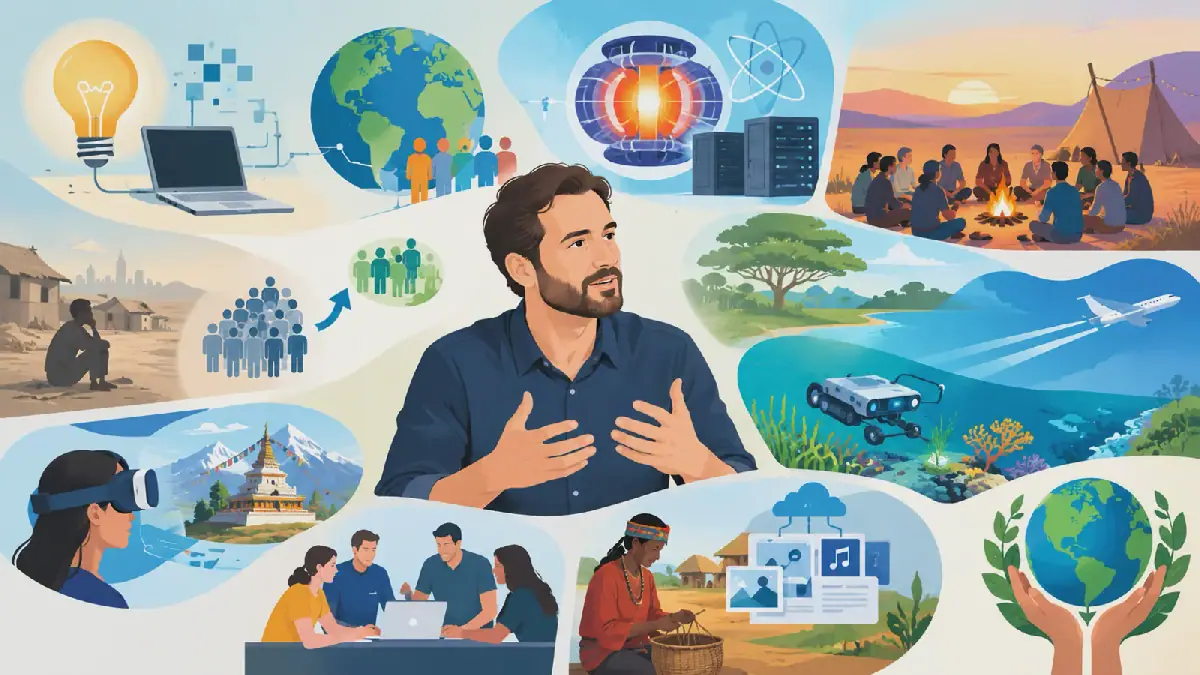
Behavioural scientist Tamás Dávid-Barrett has a unique perspective on the value of technology. According to him, the true worth of new technology lies not in the technology itself, but in how people choose to utilize it. He uses the analogy of building a lamp or a computer, emphasizing that it's what you build with it that truly matters. This approach encourages people to think creatively about the possibilities of technology and its potential to shape the future.
Dávid-Barrett believes that emerging technologies have the potential to lead to greater specialization, including regional and cultural specialization. He hopes that technology can help reduce resource pressures, strengthen human communities, and create new ways of discovering and sharing knowledge. Historically, humanity has dealt with limited resources, with estimates suggesting that around 92% of people lived in absolute poverty in 1850. Today, that number remains around 80%, largely due to issues with resource distribution.
The development of fusion energy, quantum computing, and artificial intelligence could potentially form a "three-part flywheel" that reduces resource pressures associated with basic survival. Dávid-Barrett also sees the possibility of reviving smaller human communities, similar to those that existed before farming. During the Covid-19 pandemic, some communities emerged with people coming together to cook, share food, make art, and tell stories. Artificial intelligence could help protect existing communities or establish new ones.
Technology could also revolutionize how people learn about the world. Dávid-Barrett suggests that AI assistants can provide practical guides for learning new skills, including suggestions on where to find people, materials, and opportunities. Virtual reality could allow people to experience different cultures firsthand, promoting greater awareness and understanding of cultural differences. This could encourage people to appreciate and respect diverse perspectives without having to abandon their own.
According to Dávid-Barrett, technology could enable small teams to achieve things previously associated with much larger organizations. He compares his current company to a previous business that operated in 35 countries, highlighting the benefits of agility and scale. This combination could become increasingly common, allowing smaller teams to make a significant impact. Furthermore, technology could help smaller cultures preserve their knowledge and traditions.
Dávid-Barrett's greatest concern, however, is not artificial intelligence but the decline of the biosphere. He argues that the Earth's ecological systems have collapsed five times in history and that the world is currently experiencing a sixth major collapse. Artificial intelligence could help develop models showing the relationships between living systems, human activity, and the economy, ultimately leading to practical solutions. For example, robots could be used to plant seagrass, accelerating the process and supporting the marine ecosystem.
Ultimately, Dávid-Barrett believes that the future will be shaped not only by the technology that becomes available but by the choices people make about how to use it. He encourages people to act and experiment, rather than simply relying on new systems to provide resources. By making conscious choices, people can create a better future for themselves and for generations to come. As Dávid-Barrett puts it, "What you do is what will happen."
Key points
- The value of technology lies in how people choose to use it.
- Emerging technologies have the potential to reduce resource pressures and strengthen human communities.
- Artificial intelligence could help preserve cultural knowledge and promote greater awareness of cultural differences.