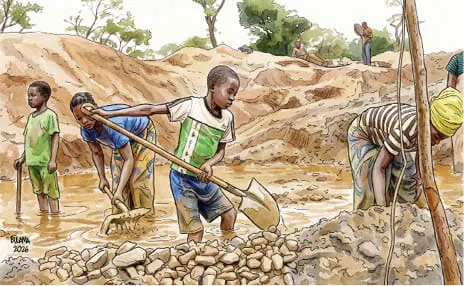
In many mining communities across Nigeria, children are waking up before dawn to head to mining sites, armed with shovels and pans, to dig for gold and other minerals. This harsh reality is a result of poverty, limited access to education, and the need for additional household income. Children as young as 7 years old are involved in mining activities, often working alongside adults, and are exposed to dangerous chemicals, heavy-duty machinery, and long hours of physical work.
Nasarawa State is one of the leading states in Nigeria with large deposits of mineral resources, earning it the slogan "Home of Solid Minerals." The abundance of these resources has led to an influx of people, including underage children, into the state in search of minerals to trade and earn a living. A recent visit to the Court Road mining site in Nasarawa Eggon Local Government Area revealed hundreds of children engaged in mining activities, with some accompanied by their parents and others under the care of their masters.
Uzina Ibrahim, a 7-year-old child miner, has never been enrolled in school and works daily at the tin mining site to earn a living. Her duties involve packing sand from dug holes and washing it to extract tin, for which she earns a maximum of N1,500 daily. She identified scarcity of water as a major challenge, stating that if not for the rainy season, they wouldn't be able to work. Uzina works alongside her mother, who gives her N1,500 or a little below as her remuneration.
Lawrence Nanlep, a 15-year-old from Qua'an Pan Local Government Area, is involved in digging, washing, and selling minerals under a boss identified as Christian, who pays him N10,000 daily. He stated that he doesn't attend school and enjoys the work, with no plan to leave it for another trade. Abdulmajid Habibu, a 14-year-old from Doguwa Local Government Area of Kano State, mines iron ore and said mining was his only job. His daily income varies between N1,000 and N10,000, and he lamented that non-payment of wages by employers is a major challenge.
Adamu Yusuf, a 17-year-old miner in Nasarawa Eggon Local Government Area, has spent the last year and a half working on mining sites in search of solid minerals. He works under a sponsor who engages them to work at different sites within the area, and they excavate both mechanically and manually. Yusuf makes between N10,000 and N15,000 from the job, which he uses to take care of himself and support his mother and younger siblings. He admitted that mining is associated with hazards, including sustaining injuries and falling sick from inhaling dust from minerals.
Shuaibu Suleiman, a 21-year-old miner, has been involved in mining for three years, which has become part of his life since he dropped out of school in JSS 2. He started mining when he followed his mother to the site to assist her in washing minerals and began assisting excavators. Suleiman works in groups with other miners under one sponsor, who takes care of their feeding without any additional allowance. The benefit-sharing system involves sharing the extracted minerals among the group members.
Addressing child labor in Nigeria's mining communities requires addressing the economic conditions that push families into it and ensuring that every child has a realistic path back to education and a safer future. The recent incident in Niger State, where 37 teenage miners died tragically while in custody, highlights the need for urgent action. Behind every mining statistic is a child-miner whose childhood may be shaped by poverty and work instead of classrooms.
Key points
- Children as young as 7 years old are engaged in mining activities in Nigeria, often in hazardous conditions.
- Poverty, limited access to education, and the need for additional household income are among the factors associated with children entering the mining sector.
- Addressing child labor in Nigeria's mining communities requires addressing the economic conditions that push families into it and ensuring that every child has a realistic path back to education and a safer future.