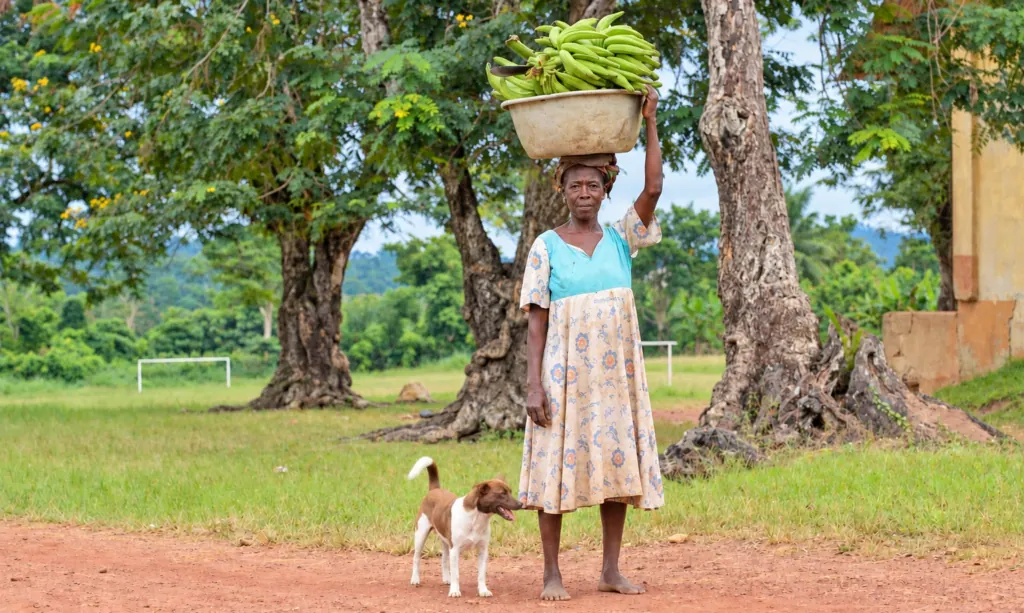
Maame Akosua Konadu, a rural Ghanaian woman, embarks on a daily 20-kilometer journey from her farm in Akroso, Eastern Region, to the local market, carrying a large pan of freshly harvested plantains on her head. Her story represents the struggles of thousands of women in rural Ghana, where poverty is a harsh reality. With a family to cater to, Maame Akosua has limited options to earn an income, making her journey a necessary but arduous task.
Agriculture is a vital source of livelihood in Ghana, with about five million people employed in the sector, according to the Ghana Statistical Service’s 2025 Quarterly Labour Force Survey. However, the survey also highlights the dominance of own-account work, particularly among women, rural workers, and people engaged in agriculture, reflecting the persistence of informal and less secure livelihoods. This reality underscores the challenges faced by rural women like Maame Akosua.
For rural women, having work is not enough; it must be productive work that generates sufficient income to provide security. A 2025 paper on women and sustainable community development in Africa identifies limited access to financial resources, discrimination, and inadequate property rights as significant obstacles to women’s economic advancement. These challenges hinder women like Maame Akosua from accessing credit, as they lack collateral, such as land and other assets.
The lack of access to finance creates a cycle of poverty, where women struggle to expand production, and income remains low. Without increased production, women like Maame Akosua cannot afford transportation, storage, and processing facilities, making it difficult to improve their livelihoods. This cycle is further complicated by the fact that women often work agricultural land without owning or controlling it, limiting their ability to use it as collateral for loans.
The long journey to the market also highlights the issue of time, as women frequently combine income-generating activities with unpaid care work. A study notes that women carry a disproportionate share of household and caregiving responsibilities, limiting their time for education, employment, and economic advancement. For Maame Akosua, every kilometer walked is time spent securing an income that must compete with family responsibilities.
Poverty and gender inequality reinforce each other, with progress in women’s empowerment being uneven, according to a 2026 study using Ghana Demographic and Health Survey data. Women like Maame Akosua face significant burdens, including unpaid care and domestic work, with women and girls aged 15 and above spending 15.5 percent of their time on such work, compared to 4.6 percent for men. This reality underscores the need for interventions to address these challenges.
Empowering women economically can strengthen households and local economies, as women often reinvest earnings in their families and communities. To achieve this, systems around them must reduce barriers that make survival costly. Interventions such as better rural roads, affordable transportation, access to affordable credit, and education can make a significant difference in the lives of women like Maame Akosua, enabling them to break the cycle of poverty and improve their livelihoods.
Key points
- Limited access to financial resources and lack of collateral hinder rural women’s ability to access credit and improve their livelihoods.
- Women in rural Ghana face significant challenges in accessing income, food, and family survival due to physically demanding and poorly rewarded work.
- Empowering women economically can strengthen households and local economies, as women often reinvest earnings in their families and communities.