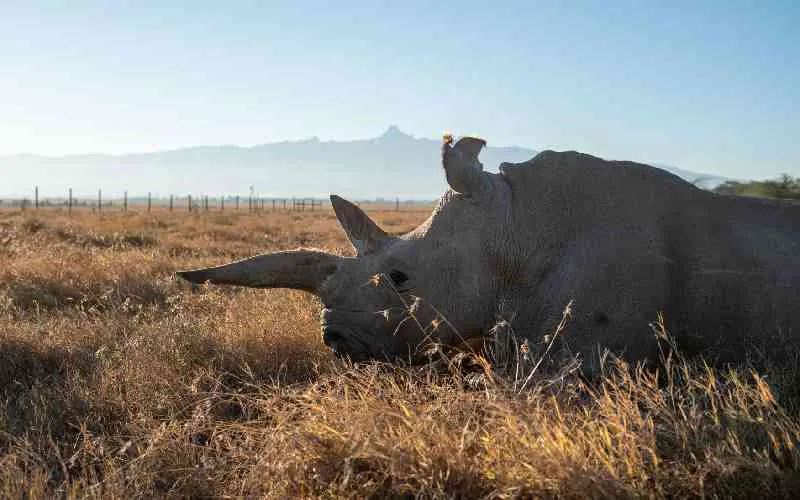
The northern white rhino, once found in Uganda, Chad, Sudan, the Central African Republic, and the Democratic Republic of Congo, is now considered extinct in the wild. Civil unrest and poaching have reduced the species to just two ageing females, Najin and Fatu, living under round-the-clock protection in Kenya. The two females are the living remnants of a population that conservationists once hoped could be saved by moving the last survivors to safety in zoos in the Czech Republic and US.
In 2009, four northern white rhinos - Najin, Fatu, Sudan, and Suni - were airlifted to Kenya and later driven to Ol Pejeta Conservancy. The plan was to return the animals to an environment closer to the one in which their ancestors evolved and give them another chance to breed. However, nature could not undo decades of human destruction. Suni died in 2014, followed by Sudan, the last male northern white rhino, in March 2018.
With the two males gone and veterinary examinations showing that the surviving females could not reproduce naturally, conservationists were left with an extraordinary problem: how to create a new generation from two females who could not carry a pregnancy. Najin's problem is partly physical, with deformities in her hind legs that make it difficult for her to bear the additional weight associated with pregnancy. Fatu, meanwhile, has a uterus that prevents her from carrying a pregnancy to term.
Despite these challenges, Fatu's ovaries continue to provide viable eggs, making her central to efforts to preserve the northern white rhino's genetic future. The BioRescue Consortium, an international alliance of scientists working on the project, has so far produced 39 northern white rhino embryos, which remain part of a painstaking attempt to produce a calf through assisted reproduction.
The embryos cannot simply be implanted into Najin or Fatu; scientists need suitable southern white rhino surrogate mothers to carry the pregnancies. To prepare the northern white rhinos for a potential future with surrogate mothers, a southern white rhino named Tauwo was introduced to Najin and Fatu in 2018. Tauwo formed a strong bond with Fatu, teaching her behaviours she might need in a natural environment.
The caregivers have learned to understand the unique personalities and behaviours of Najin and Fatu. Najin is generally calm and familiar with her caregivers, while Fatu is more sensitive to disturbance and requires a more gentle approach. The animals also exhibit normal rhino behaviours, such as grazing on grass, resting, drinking water, and sharpening their horns.
The fight to save the northern white rhino is an ongoing and complex process. While conservationists have made significant progress in preserving the species' genetic material, the challenge of producing a viable calf through assisted reproduction remains. The story of Najin and Fatu serves as a poignant reminder of the impact of human activities on the natural world and the importance of conservation efforts to protect endangered species.
Key points
- The northern white rhino is considered extinct in the wild, with only two ageing females remaining in Kenya.
- Conservationists have produced 39 northern white rhino embryos through assisted reproduction, but require suitable surrogate mothers to carry the pregnancies.
- The caregivers have learned to understand the unique personalities and behaviours of Najin and Fatu, which is crucial for their care and potential future breeding.