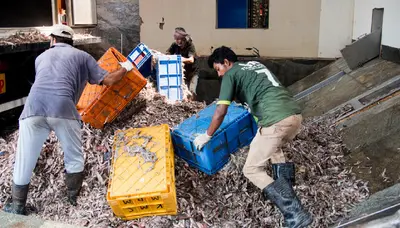
A recent investigation by The Outlaw Ocean Project has exposed the hidden costs of the global seafood trade, particularly in the production of fishmeal. The industry, which generates millions of dollars in tax revenue and creates thousands of jobs, has also led to chronic chemical exposure, avoidable worker deaths, and violent protests in poorer coastal communities. The investigation found that the fishmeal industry's rancid odour is among the least tracked yet most widely suffered impacts of this growing market.
The fishmeal industry has expanded rapidly over the past decade, with foreign investment pouring into West Africa to build factories geared towards export markets in Europe and Asia. By 2019, roughly 50 fishmeal and fish oil plants were operating across Mauritania, Senegal, and The Gambia, consuming an estimated half a million metric tons of fish each year. This growth has led to concerns about the environmental and health impacts of the industry, particularly in communities near the factories.
Neighbours of fishmeal plants have reported a range of health problems, including nausea, headaches, eye irritation, dizziness, coughing fits, and loss of appetite. The investigation documented over 70 cases of neighbours complaining about the stench from at least 60 plants in 15 countries. The stink from these plants is not just a nuisance, but also an indicator of the release of noxious chemicals like ammonia, hydrogen sulfide, cyanide, and methane, which have been known to cause serious health problems.
The worst part of the stench is from trimethylamine, or TMA, a colourless gas characterised by a "fishy" smell. In 2021, the Society of Chemical Industry identified TMA as "strongly toxic and carcinogenic". Humans' sensitivity to foul odours can bring intense feelings of disgust and anxiety, leading to negative health consequences when exposures last longer than several minutes. However, little research has concentrated on the impact of olfactory nuisance.
In many countries, chemical waste is closely regulated, but emitting bad smells is typically seen as more of an inconvenience. Most fishmeal plants are located in poorer nations or regions where zoning laws either do not exist or are not applied. In Senegal, for example, zoning rules forbid fishmeal companies from building plants within 500m of a residential area, but the investigation found that the rule was routinely violated.
The investigation also found that investors often promise to install technology to control the odour, but these commitments are rarely respected once the factory is operational. In Nouadhibou, Mauritania, researchers found that the factories frequently polluted the air, leading to asthma and skin diseases among children and the elderly. The lack of regulation and enforcement has led to concerns about the long-term impacts of the industry on local communities.
The global fishmeal industry has grown rapidly in recent years, with half of the seafood eaten globally now coming from fish farms powered by fishmeal and fish oil. More than 9.5 million people worldwide live within 1.5km of fishmeal plants, according to Bait to Plate, an online tool that tracks the fishing and seafood industries. As the industry continues to grow, concerns about its environmental and health impacts are likely to increase.
Key points
- The fishmeal industry's growth has led to chronic chemical exposure, avoidable worker deaths, and violent protests in poorer coastal communities.
- The industry's rancid odour is among the least tracked yet most widely suffered impacts of this growing market.
- Zoning laws and regulations are often not applied in poorer nations or regions where fishmeal plants are located.