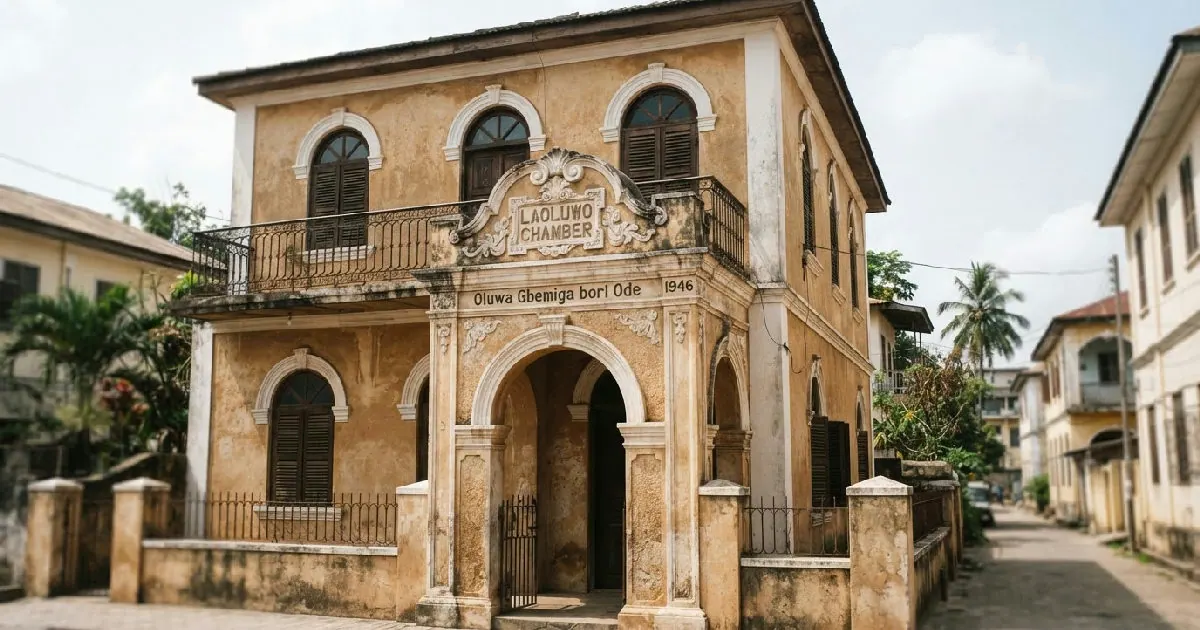
A black-and-white photograph from mid-century Lagos showcases a building that tells a remarkable story of Nigeria's Brazilian returnees. The structure features elegant arches and ornate plasterwork characteristic of Brazilian architecture, yet bears a Yoruba inscription, “Oluwa Gbemiga bori Ode,” and displays the year 1946 over an archway marked “Laoluwo Chamber.” This building is a testament to the lasting legacy of Nigerians who were taken as slaves, forged a new identity in Brazil, and returned to their ancestral homeland, changing the face of Lagos forever.
The history of Lagos is often told through its indigenous origins and British colonial capital status, but a crucial thread has been overlooked. Starting in the 1820s, waves of formerly enslaved Africans, primarily of Yoruba descent, began returning to West Africa from Brazil, known as the Agudas. By the 1880s, they accounted for nearly a tenth of Lagos’s population. These returnees brought new skills, Catholicism, Portuguese names, and a unique cultural identity forged in Brazil. They settled on Lagos Island in the area known as Popo Aguda, the Brazilian Quarter, which was formally demarcated in 1852.
The Agudas were not just re-assimilating; they were actively building a new Lagos in their own image. They introduced a new architecture, having worked in Brazil’s construction industry as master masons, carpenters, and bricklayers. They brought the sobrado, the iconic two-storey Brazilian townhouse, to Lagos, featuring ornate plaster facades, elegant archways, and decorative ironwork. These houses were statements of prosperity, resilience, and a worldly identity. The style became an instant sensation, and soon, wealthy Yoruba merchants and prominent Lagosians began commissioning Afro-Brazilian artisans to build houses for them.
The Agudas’ influence extended deep into the city’s spiritual life. While many returnees were Catholic, the community was diverse, with figures like Saliu Salvador Ramos das Neves, a Yoruba Muslim, founding one of Popo Aguda's oldest mosques. In Catholicism, their building skills found monumental expression in the Holy Cross Cathedral, built by Brazilian master craftsmen Lazaro Borges da Silva, Francisco Nobre, and Marcellino Ferreira. Their contribution was fundamental, and Brazilian artisans were again involved in the construction of the new cathedral in 1934.
The building marked 1946 is significant, as it shows how thoroughly the Afro-Brazilian aesthetic had been absorbed into Lagos’s visual language. Documented by British educator Edward Harland Duckworth, the house reflects the continuation of building traditions that had powered the broader transformation of Lagos for decades. Its existence in the mid-20th century is proof that the Aguda did not just build houses; they built a tradition that outlived them, shaping how Lagosians saw and built their city for generations.
The story of Popo Aguda is more than one of architectural influence. The returnees established businesses, participated in Atlantic commerce, and worked as skilled artisans and laborers, contributing to Lagos’s economic growth. Their descendants continued to develop identities shaped by both African ancestry and Atlantic connections. This rich heritage is still celebrated today, most visibly in the Lagos Fanti Carnival, a vibrant procession of costumes and dance that echoes the cultural fusion the Agudas brought to the city.
The Aguda story is complex, marked by resilience and adaptation. These individuals endured the horror of the transatlantic slave trade and returned to an ancestral home under British colonial rule. Some participated in the commercial inequalities of the Atlantic world that had displaced them. Theirs is a human story of survival, with a hybrid identity that fused Yoruba and Brazilian cultures. They stand as a powerful example of how professional roles could emerge and shape society.
Key points
- The Agudas introduced a new architecture to Lagos, characterized by sobrados with ornate plaster facades, elegant archways, and decorative ironwork.
- The returnees brought Catholicism and other cultural practices to Lagos, contributing to the city's spiritual and cultural diversity.
- The legacy of the Agudas continues to shape Lagos's identity, with their architectural and cultural influence still visible today.