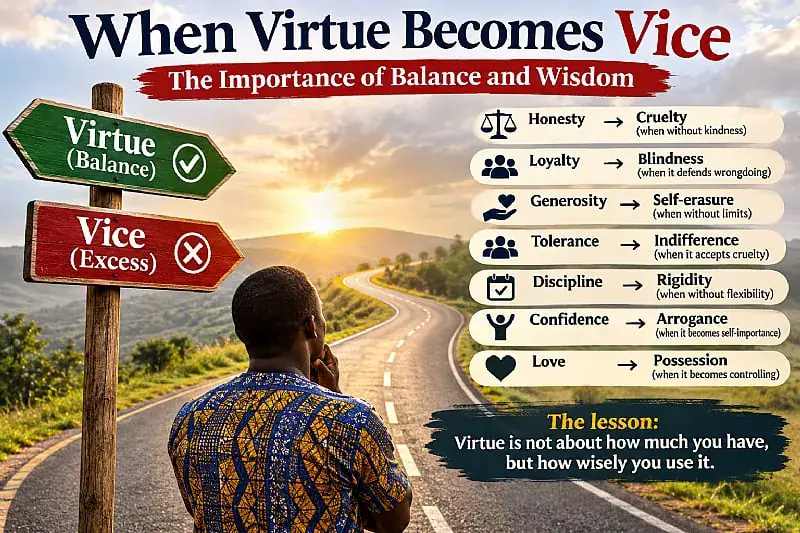
In Ghana, as in many societies, virtues like honesty, loyalty, and courage are highly valued. However, when exercised without wisdom, moderation, and restraint, these admirable qualities can produce harmful consequences. The Greek philosopher Aristotle first explained this principle through his doctrine of the Golden Mean over 2,300 years ago. This doctrine emphasizes the importance of avoiding excess and deficiency in the pursuit of virtue.
The concept of the Golden Mean suggests that virtues like courage, honesty, and loyalty must be exercised in balance. For instance, courage lies between cowardice and recklessness. True virtue requires knowing how and when to act appropriately. Without this balance, virtues can quickly become vices. Honesty without compassion can become cruelty, while loyalty without accountability can lead to blind support for wrongdoing.
In Ghanaian society, the consequences of virtues taken to excess are particularly relevant. Political loyalty, ethnic affiliations, religious commitment, and personal relationships often influence people's willingness to condemn wrongdoing. Defending corruption or misconduct simply because someone belongs to one's political party, family, or community is not loyalty but complicity. This kind of thinking can undermine democracy, accountability, and national development.
Leaders, in particular, must be mindful of the dangers of virtues taken to excess. When leaders confuse confidence with arrogance, discipline with authoritarianism, or patriotism with unquestioning obedience, they risk eroding trust and damaging their communities. A good leader must be courageous without being reckless, firm without being oppressive, loyal without compromising integrity, and confident without rejecting criticism.
The challenge is not to abandon virtues but to exercise them with sound judgment. Virtue does not always mean choosing the middle position or avoiding difficult decisions. Sometimes justice demands firm action, courage requires significant sacrifice, and integrity calls for an uncompromising stand. What matters is whether our actions are guided by wisdom, fairness, and responsibility.
As individuals and as a nation, Ghanaians must recognize that good intentions alone do not guarantee good outcomes. Moral maturity requires self-awareness, restraint, and the ability to balance competing responsibilities. This means being aware of one's own biases and limitations, as well as being willing to listen to opposing viewpoints and adapt to changing circumstances.
Ultimately, true virtue is not measured by how strongly we display our good qualities, but by how wisely we exercise them. The greatest danger is not virtue itself, but virtue without wisdom. A truly good person knows not only when to act but also when to exercise restraint. By cultivating this kind of wisdom, Ghanaians can build a more just and equitable society.
Key points
- Virtues like honesty, loyalty, and courage can become vices when exercised without wisdom, moderation, and restraint.
- The concept of the Golden Mean can help individuals and leaders balance competing virtues and avoid excess and deficiency.
- Moral maturity requires self-awareness, restraint, and the ability to balance competing responsibilities.