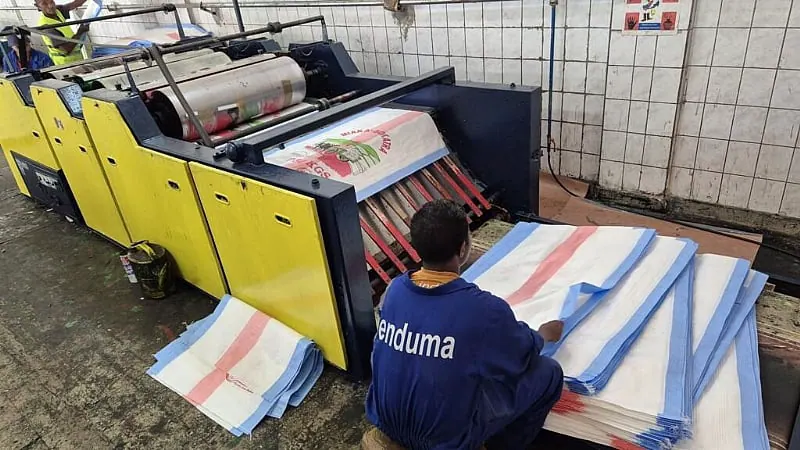
In Tanjombato, on the outskirts of Madagascar's capital Antananarivo, the Enduma company has been producing its hardy "gony" bags for five decades. The company's vast warehouse operates round the clock, with six-shuttle circular weaving machines transforming tiny plastic pellets into bags. These machines work at full capacity, generating a deafening din as they produce the sacks that have become a familiar sight throughout Madagascar.
The classic Miaka-bokatra bag, literally "harvest season," is the company's most popular product. Bearing a picture of a cart drawn by two zebu cattle, these large white gony sacks can carry up to 250 kilos of produce. Originally designed to replace jute sacks, they have become indispensable in industry and for farmers. The bags mark the start of the rice harvest season and have come to symbolize Madagascar.
Enduma generates 75 percent of its turnover in Madagascar, mainly during peak agricultural seasons. The company's success is intimately entwined with the state of Madagascar's crops, the weather, and its knock-on effects. According to Hassanein Hiridjee, the founder's grandson and CEO of the Trimeta Group, the conglomerate that owns Enduma, the company supplies various farming sectors during their harvest seasons.
The rhythm of the various harvests keeps demand high throughout the year, with the start of the year focused mainly on rice, followed by vanilla, pulses, Cape peas, and salt. Hiridjee explains that the better the harvests, the more bags the company sells. However, Enduma faces challenges, including recurring power cuts and competition from imported woven bags made in China or India.
The imported bags are often of lesser quality, lack traceability, and are not certified safe to be in contact with food. They are also sold at lower prices, posing a challenge to Enduma. To address this, the company has decided to diversify its activities, including recycling and processing production waste into granules, which are then used to make basins, buckets, and other products.
Enduma celebrates its 50th anniversary at the end of the year, and as a still entirely family-owned company, it aims to scale up its operations. The company is banking on its gony bags to power its development, hoping to export Malagasy expertise over the Indian Ocean and across the African continent. This will enable Enduma to expand its reach and increase its market share.
As Enduma looks to the future, it is focused on building on its success and exploring new opportunities. With its commitment to quality and sustainability, the company is well-positioned to continue playing a significant role in Madagascar's economy. The gony bag has become an integral part of Malagasy culture, and Enduma is poised to continue meeting the demands of the market.
Key points
- Enduma company has been manufacturing gony bags for 50 years, transforming plastic pellets into familiar sacks used throughout Madagascar.
- The company's success is intimately entwined with the state of Madagascar's crops, the weather, and its knock-on effects.
- Enduma aims to scale up its operations and export Malagasy expertise over the Indian Ocean and across the African continent.