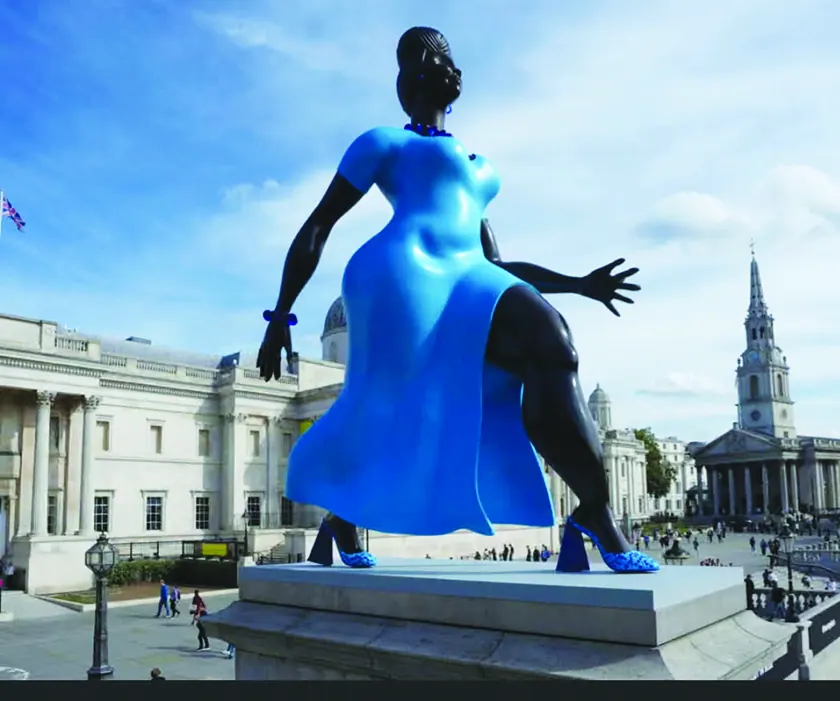
A new sculpture has been unveiled on London's Fourth Plinth in Trafalgar Square, offering a contemporary image of womanhood. Tschabalala Self's "Lady in Blue" is a 10-foot bronze sculpture finished in a striking lapis-lazuli blue patina, depicting a self-assured young metropolitan woman striding forward. The sculpture celebrates "the diversity and optimism of everyday city life" rather than a historical idol, according to the artist.
The timing of the unveiling, on September 10, coincided with a three-day spiritual festival that called upon earthly womanhood to awaken to its divinely ordained role. This juxtaposition has sparked reflection on the different conceptions of womanhood. While "Lady in Blue" represents the contemporary woman as imagined by the cultural establishment, another conception of womanhood as a spiritual responsibility also exists.
The Fourth Plinth has a long history, dating back to 1841 when Charles Barry designed Trafalgar Square. The plinth was intended for an equestrian statue of King William IV, but the money ran out before the statue could be made, leaving it empty for over 150 years. In 1994, Prue Leith suggested giving the plinth a new purpose: a changing display of contemporary art.
The Royal Society of Arts began a trial of the new concept in 1998, with Mark Wallinger's "Ecce Homo" being the first installation. Since then, the plinth has had a range of memorable occupants, including Bill Woodrow's "Regardless of History" and Dame Rachel Whiteread's "Monument". The programme has been overseen by an independent Fourth Plinth Commissioning Group and the Mayor of London's Culture Team.
The selection process for the plinth's occupants involves shortlisting artists and inviting members of the public to vote. A new work generally appears every two years. The plinth has hosted several notable installations, including Marc Quinn's "Alison Lapper Pregnant" and Antony Gormley's "One & Other".
Yinka Shonibare's "Nelson's Ship in a Bottle" was another notable installation, presenting a model of HMS Victory. The Fourth Plinth has become a platform for contemporary artists to showcase their work to a wide audience. The unveiling of "Lady in Blue" continues this tradition, sparking conversation and reflection on the image of womanhood it presents.
Tschabalala Self's "Lady in Blue" will remain on display on the Fourth Plinth for two years, offering Londoners and visitors the opportunity to engage with the sculpture and its message. The sculpture's presence in Trafalgar Square, a prominent public space, ensures that it will be seen and experienced by a large and diverse audience.
Key points
- The sculpture "Lady in Blue" represents a contemporary image of womanhood as imagined by the cultural establishment.
- The Fourth Plinth has a long history, dating back to 1841, and has hosted several notable installations since 1998.
- The selection process for the plinth's occupants involves shortlisting artists and inviting members of the public to vote.