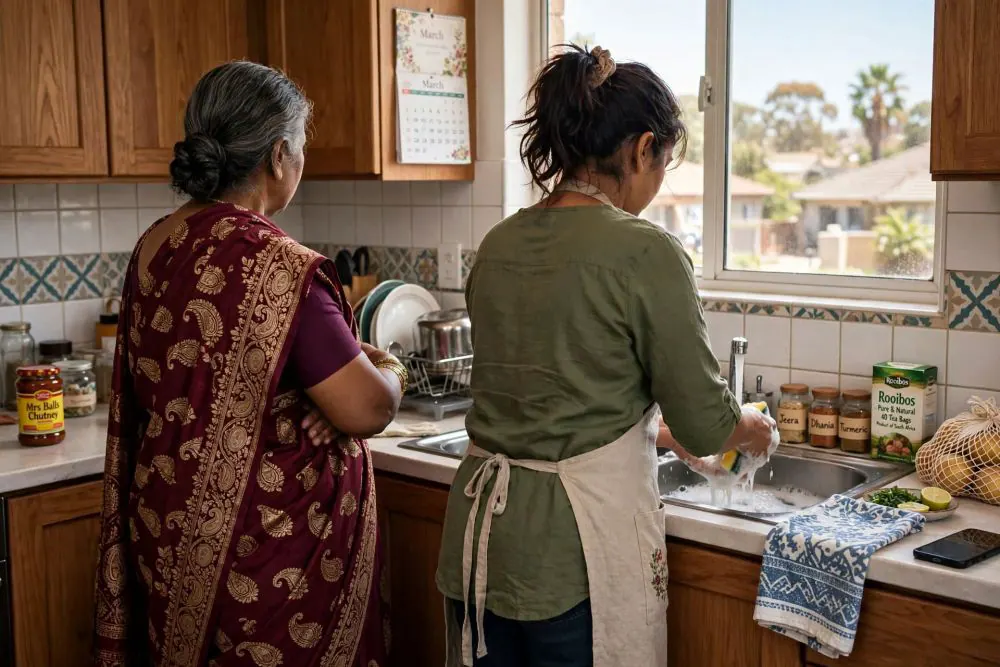
A recent Facebook post praising an Indian daughter-in-law for taking over household chores sparked controversy. The writer, Dr Shamila Ramsookbhai, argues that this mindset is a deeply entrenched problem in many communities, where women's worth is measured by their domestic competence. This conditioning starts from childhood, where girls are taught that domestic skills are a measure of their character. The writer believes that this approach is not only limiting but also damaging to women's self-esteem and identity.
The writer notes that women often perpetuate this culture by judging each other based on their domestic abilities. Mother-in-laws judge daughters-in-law, and daughters-in-law compare themselves with others. This creates an exhausting competition where women feel pressured to be perfect in their domestic roles. The writer argues that this approach neglects the most important question: Is she happy? The writer believes that women's lives should be about more than just serving others and that they should be free to pursue their own dreams and interests.
The writer criticizes the tendency to romanticize exhaustion and praise women for doing everything. Instead, she argues that women should be given the freedom to say no to certain tasks and prioritize their own needs. The writer also believes that domestic perfection should not be passed down from one generation to another. With technology and changing social norms, women should be able to live differently and make choices that work for them.
The writer highlights the double standard that exists in many societies, where women are judged more harshly for an untidy home than men. A man who cannot cook is often seen as amusing, while a woman who cannot cook is seen as deficient. The writer argues that this double standard needs to be challenged and that women should be given the same freedoms and opportunities as men.
The writer emphasizes the importance of teaching girls and women that their lives belong to them. They should be encouraged to pursue education, build careers, and care for themselves, not just others. The writer also believes that men need to be taught that domestic responsibility is a shared burden, not just a woman's unpaid workplace.
The writer wants the next generation of women to compete over who can dream the biggest, not who can sacrifice the most. She wants women to walk into a room without worrying about what others think of their kitchen or domestic abilities. The writer believes that women should be free to live their lives, think, create, and discover without being defined by their domestic roles.
The writer concludes that the kitchen sink is not a measure of a woman's character. A woman's worth should not be measured by her domestic abilities, but by her individuality, talents, and contributions to society. The writer hopes that her daughters and future generations will be able to live beyond the kitchen sink and pursue their own paths in life.
Key points
- The writer argues that women's worth should not be measured by their domestic competence.
- The double standard in judging women's domestic abilities needs to be challenged.
- Women should be free to pursue their own dreams and interests beyond their domestic roles.