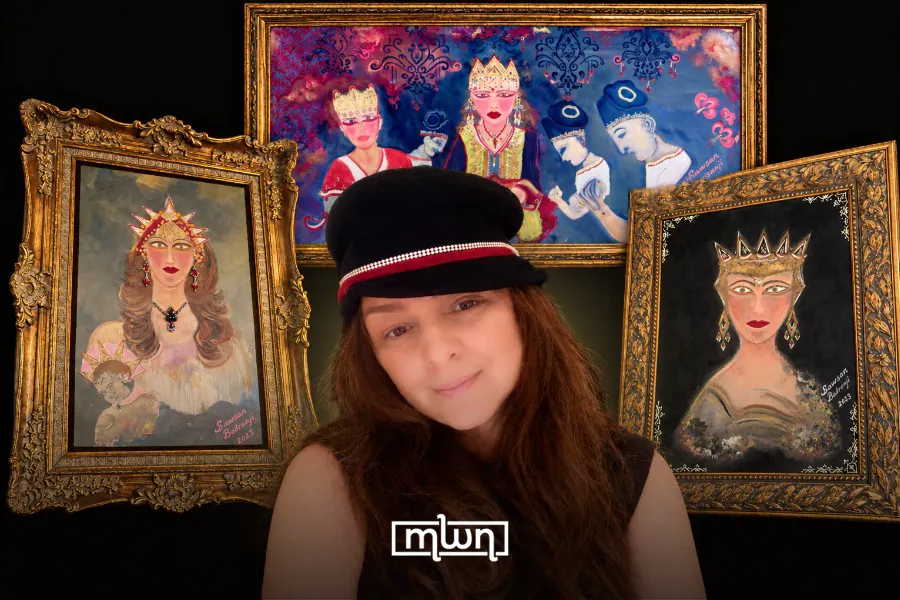
Soundousse Belayachi, a painter and designer, has created a body of work that showcases Amazigh women as the keepers of a rich cultural heritage. Her paintings feature women with intricate jewelry, tattoos, and textiles that carry stories of identity, memory, and belonging. According to Mohamed Chtatou, Belayachi's work restores to visibility a form of historical agency that has been underserved in the written archive of North Africa. This agency has been carried on the bodies and in the hands of women, who have played a crucial role in transmitting Amazigh culture from one generation to the next.
Belayachi's portraits invert the customary hierarchy of North African historiography, where dynasties, wars, and male scholars occupy the foreground, while the domestic and artisanal labor of women recedes into anonymity. Her women are instead cast as active custodians of a non-written archive, woven into carpets, painted onto skin, hammered into silver, and sung into lullabies. This archive is not a nostalgic gesture toward a vanished past but a claim about historical method, highlighting the importance of looking at the transmission of culture in the hands of mothers, weavers, and artisans.
The face is a site of meaning in Belayachi's paintings, with her women holding expressions that resist a single emotional register. Their dignity shades into meditation, pride into quiet melancholy, and serenity into vigilance. This ambiguity is deliberate, as a face rendered as pure serenity would risk collapsing into the picturesque. Belayachi's treatment of the face carries particular weight given the historical role of facial ornamentation in Amazigh communities, where tattooing, jewelry, and ceremonial adornment communicated belonging, fertility, protection, and social status.
Facial tattooing among Amazigh women marked distinct phases of a woman's life and was applied from a young age, with placement carrying specific meaning. A line on the chin could signal an engagement, while a mark near the nose might indicate marriage or the loss of a child. Belayachi detaches these elements from a purely ethnographic frame and reintegrates them into a contemporary visual language without erasing their legibility as traditional signs. Heritage, in this rendering, does not belong exclusively to the museum vitrine or the archaeological catalogue but can live directly in a face, hairstyle, fibula, or tattooed line.
Belayachi's women are not simply subjects but guardians and archives of Amazigh culture. They control the visual vocabulary of Amazigh identity, its motifs, colors, and silhouettes, conferring upon them both social prestige and cultural authority. This authority was never merely symbolic, as a woman who understood which fertility symbol belonged on which textile or which tattoo pattern signaled a particular lineage possessed a technical and social competence indistinguishable from scholarship.
Adornment occupies a privileged place in Belayachi's iconography, with jewelry, tattoos, and dress serving as declarations of self, transmitted publicly and read collectively. A fibula pinned at the shoulder announced region, marital status, and lineage as unambiguously as a written seal, while a tattoo traced along the chin or forehead carried protective and social meaning legible to anyone versed in the code. Belayachi's insistence on rendering these elements highlights the public testimony of Amazigh women.
Belayachi's portraiture performs a quiet correction of the ethnographic gaze that historically reduced Amazigh women to specimens of costume and custom rather than agents of meaning. Her women hold their gaze toward the viewer with a steadiness that refuses supplication, asserting the authority of those who know what the symbols around them mean. By making this authority visible, Belayachi's paintings challenge conventional narratives of women as mere consumers, rather than producers and adapters, of culture.
Key points
- Soundousse Belayachi's paintings highlight the crucial role of Amazigh women in preserving cultural heritage and identity.
- Belayachi's work challenges conventional narratives of North African historiography, giving visibility to the domestic and artisanal labor of women.
- The artist's use of facial ornamentation, jewelry, and tattoos as symbols of cultural identity and authority underscores the importance of these elements in Amazigh culture.