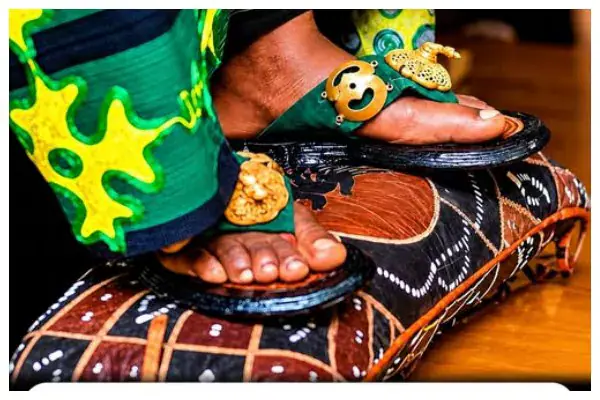
In Asante tradition, the Asantehene and paramount chiefs use a black footstool called the Akorowa when seated in state. The footstool, oval-shaped and resembling a canoe, is traditionally carved from apuro, a solid white wood, and painted black with exposed natural wood parts. Its use is reserved for the Asantehene and paramount chiefs, particularly when occupying royal seats such as the Hwidɔm, Asipim and Akronkromfi chairs.
The Akorowa footstool plays a significant role in Asante traditional system, carrying deep cultural, spiritual and political weight within Asanteman. When the Asantehene takes his seat, his feet rest on the Akorowa, which is placed on banwoma — skins traditionally obtained from animals such as lions or elephants — or a black-and-white cloth called nsaa on certain occasions. This practice represents the Asantehene's jurisdiction over the Asante Kingdom and his position as the supreme traditional authority.
The Akorowa footstool is decorated with nsɛbɛ, or amulets, fixed to its upper surface, sides and base. Traditional belief holds that these amulets guard the king against spiritual dangers believed to enter the body through contact with the earth. The footstool's design and use symbolize the weight Asante custom places on royal dignity, spiritual protection and the continuity of the kingdom.
The black-and-white nsaa cloth that sometimes sits beneath the footstool has its own symbolism within Asante custom. Its colours are associated with quality, durability, hope, abundance and bumper harvests. The nsaa cloth, along with the footstool and its protective amulets, points to the significance Asante custom places on royal dignity and spiritual protection.
The Akorowa remains part of the ceremonial trappings on display whenever the Asantehene appears in state, alongside other royal customs. Recently, Otumfuo Osei Tutu II featured at the inaugural GCB Opemsuo Invitational Golf Tournament in Kumasi, showcasing the Akorowa footstool and other royal traditions. The footstool's continued use highlights the importance of traditional customs in modern Ghanaian society.
The Akorowa footstool is an essential part of Asante heritage, representing the Asantehene's authority and connection to the kingdom's spiritual and cultural traditions. Its significance extends beyond its practical use, embodying the values and customs of the Asante people. As a symbol of the Asantehene's jurisdiction, the Akorowa footstool continues to play a vital role in Ghanaian culture and tradition.
The Akorowa footstool's cultural significance is a testament to the rich heritage of the Asante Kingdom. Its use and symbolism have been preserved through generations, ensuring the continued relevance of traditional customs in modern Ghanaian society. The footstool's importance is a reflection of the Asante people's commitment to their cultural and spiritual traditions.
Key points
- The Akorowa footstool is a symbol of the Asantehene's authority and connection to the kingdom's spiritual and cultural traditions.