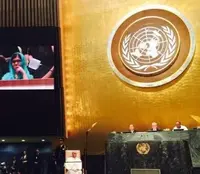
The 81st session of the United Nations General Assembly (UNGA) recently opened with the theme "Silence the guns, amplify the voices: Peace, security and justice for all." However, the current state of UN Peacekeeping presents a stark contrast to this goal. The last time the UN Security Council authorized a new peacekeeping mission was in 2014, when it approved MINUSCA in the Central African Republic. Since then, numerous conflicts have erupted or escalated globally, but not a single new blue-helmet mission has been deployed.
Peacekeeping operations require the consent of the host government, which is becoming increasingly fragile. Mali's military junta ordered MINUSMA to leave in 2023, forcing the Security Council to terminate the mission. The Democratic Republic of the Congo has pushed for MONUSCO's accelerated drawdown, while Sudan expelled UNAMID. These developments have resulted in a significant decrease in personnel deployed in multilateral peace operations, falling to 78,633 by the end of 2025, the lowest level in at least 25 years.
The UN's peacekeeping budget has also faced significant challenges, with a $2 billion shortfall, more than 35 percent of its total, in July 2025. The UN Security Council's paralysis has contributed to these challenges, with Russia casting over 20 vetoes since 2014, blocking action on Syria, Sudan, and other countries. China and the United States have also joined in on several of these votes, further hindering the Council's ability to deploy new peacekeeping missions.
The consequences of the UN's inability to deploy peacekeepers are far-reaching and devastating. Regional organizations often try to fill the gap, but they lack the legitimacy, scale, and funding that only a UN-mandated mission can provide. According to SIPRI's 2026 report, regional organizations lack key capabilities for successful peacebuilding and are plagued by funding shortfalls and an inability to reach agreement.
The problem with UN Peacekeeping runs deeper than the Security Council's paralysis. Contemporary peacekeeping operations suffer from a significant trust deficit, as argued by Cedric de Coning in his work on the stabilization dilemma. This dilemma occurs when peace operations are deployed in contexts where there is no viable political or peace process to support, leading to a perverse effect where effective protection and stability reduce the incentive for ruling elites to find long-term solutions.
The stabilization dilemma prolongs conflicts, traps operations in place with no exit options, and increases the resilience of armed groups. The Security Council's loss of trust in these operations is also a contributing factor, as it has repeatedly deployed peacekeepers into situations where there is no peace to keep. The absence of new missions since 2014 reflects a deeper loss of confidence in the instrument itself, which the Security Council has helped erode.
As UNGA 81's theme emphasizes the need to "silence the guns," the institution built to achieve this goal has been silenced by its most powerful members. A renowned blueprint for grappling with the stabilization dilemma and revitalizing UN Peacekeeping is necessary to address these challenges. Shaun Kinnes, a researcher with a special interest in climate-induced conflict, geo-politics, and regional integration, has highlighted the need for a new approach to UN Peacekeeping.
Key points
- The UN's peacekeeping budget faced a $2 billion shortfall in July 2025.
- The number of personnel deployed in multilateral peace operations fell to 78,633 by the end of 2025.
- The UN Security Council has not authorized a new peacekeeping mission since 2014.