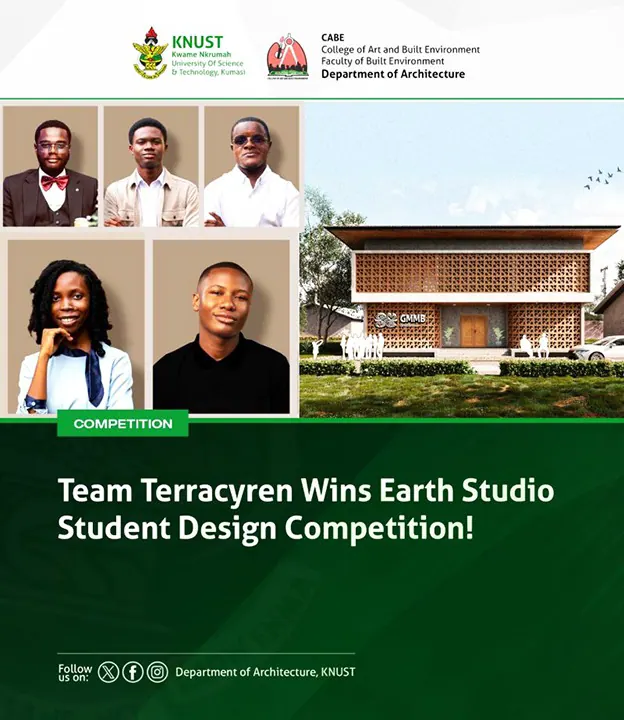
A team of fourth-year architecture students at Kwame Nkrumah University of Science and Technology (KNUST) has emerged as the winner of the EARTH Studio Student Design Competition. The team, known as Terracyren, presented a proposal for a Ghana Museums and Monuments Board (GMMB) regional office that draws inspiration from traditional Asante architecture. The competition, which was organized by the Department of Architecture at KNUST, required students to design a contemporary building using earth and local resources, rooted in Ghana's architectural heritage.
The team's design concept is based on an Asante custom where valued property is entrusted to a chosen person when the elder or head of a family nears death. The team saw the GMMB in a similar role, as the keeper of Ghana's cultural treasures, including castles and traditional buildings. The design incorporates a courtyard house concept, where the building opens onto a small courtyard with workspaces around it, providing a sense of privacy and security. This design approach is in contrast to modern buildings, which often signal their function from the street.
The design also incorporates earth construction, which was a requirement of the competition. The team drew inspiration from Asante houses, which were built using wattle and daub, a method that has stood the test of time, including through the colonial era. The use of earth construction not only provides a sustainable and environmentally friendly solution but also helps to reduce the building's reliance on air conditioning and artificial light.
According to Nana Kwadwo Agyei-Bi Asante, a member of the team and former president of the KNUST chapter of the Architecture Students' Association of Ghana (ASAG), the team considered withdrawing from the competition to protect their studio coursework but decided to proceed after discussing the project between lectures. The team was one of 15 that began the competition, with 11 teams completing the project. The final presentations were attended by students, faculty, representatives of the French earthen-architecture centre CRAterre, and the GMMB, as well as invited heritage and architectural professionals.
The team's design, dubbed a "treasure box," was chosen to evoke the idea of a pot hidden during an elder's lifetime, often near a recognizable tree or plant, and passed to a younger generation. The design features a central skylight that provides natural light and a sense of openness, while the facade's breeze blocks combine two symbols, one for holding the wisdom of the past and one for protecting it. The entrance, modelled on Asante houses, is designed to invite visitors in while signalling a protected place.
The design is also built with the climate in mind, incorporating features that reduce reliance on air conditioning and artificial light. The north and south sides of the building, which carry the breeze blocks and most openings, allow for cross-ventilation, which is essential for earth buildings to avoid mould. The east and west walls, which take the harshest sun, have no windows, and the earth walls are thicker than standard sandcrete walls, providing insulation and keeping heat out.
According to Christabel Nakuor, Vice President of ASAG, the team's research showed that earth building extends beyond rammed earth to multistorey structures reinforced with timber or bamboo, and to lime finishes described as "breathable." The team's design not only provides a sustainable and culturally relevant solution for the GMMB regional office but also showcases the potential of earth construction in modern architecture. The team's win is a testament to the creativity and innovation of KNUST's architecture students.
Key points
- The team's design incorporates traditional Asante architectural elements, including a courtyard house concept and earth construction.
- The design is built with the climate in mind, incorporating features that reduce reliance on air conditioning and artificial light.
- The team's win is a testament to the creativity and innovation of KNUST's architecture students.