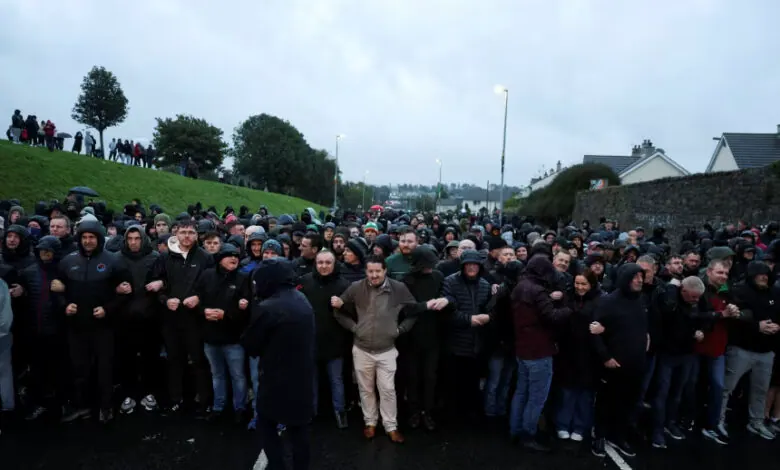
A highly anticipated and contentious parade by the Orange Order, a group that supports Northern Ireland remaining part of the UK, was given the go-ahead by the High Court in Belfast on Sunday. The parade, which marks the first time in almost 30 years that the Orange Order has been allowed to march down Garvaghy Road in Portadown, was initially met with resistance from thousands of protesters. Many of the protesters, wearing balaclavas, gathered to block the marchers from proceeding down the road, a notorious flashpoint before the Good Friday Agreement of 1998.
The situation escalated as fireworks were set off near the starting point of the parade about five minutes before its 8 a.m. start time. Protesters were subsequently notified on a loudspeaker that they would be liable for arrest for taking part in an unlicensed counter parade. The authorities' move to allow the parade to proceed has reignited tensions in the region, where Irish nationalists, mostly Catholic, seek union with the Republic of Ireland, while largely Protestant unionists want to remain part of the UK.
British Prime Minister Andy Burnham called for calm in Northern Ireland on Sunday, urging all sides to exercise restraint. Burnham emphasized that significant progress had been made in the region and that efforts should not be undermined. He appealed for “calm on all sides” over the parade, highlighting the need to maintain stability and avoid a return to the violence of the past.
The parade's approval was granted at a court hearing that concluded at 2:15 a.m. on Sunday. The decision was met with criticism from some quarters, including Mary Lou McDonald, the president of Sinn Fein, the party historically linked to the Irish Republican Army. McDonald described the move as “madness” and stated that the people of Garvaghy Road would “not be drawn back to the past.”
In response, Gavin Robinson, the leader of the Democratic Unionist Party, the largest pro-UK party in Northern Ireland, defended the court's decision and criticized Sinn Fein leaders for inflaming the situation. Robinson argued that the rule of law must be respected and that institutions in Northern Ireland are founded on respect for the police, courts, and the rule of law.
The background to the tensions in Northern Ireland lies in the complex history of the region. The Good Friday Agreement of 1998 largely ended the bloodshed known as the Troubles, which left 3,600 people dead, some 50,000 wounded, and thousands bereaved. The agreement aimed to balance competing identities in Northern Ireland, which remains part of the United Kingdom while the rest of Ireland gained independence a century ago.
The controversy surrounding the Orange Order parade highlights the ongoing challenges in Northern Ireland, where deep-seated divisions between Irish nationalists and unionists persist. As the region continues to navigate its complex history and politics, efforts to maintain peace and stability remain crucial. The situation will likely continue to be closely watched by both local and international observers.
Key points
- The Orange Order parade was allowed to proceed down Garvaghy Road in Portadown, a notorious flashpoint, for the first time in almost 30 years.
- British Prime Minister Andy Burnham called for calm in Northern Ireland, urging all sides to exercise restraint and avoid undermining progress made in the region.
- The decision to allow the parade to proceed was met with criticism from some quarters, including Sinn Fein leaders, who described the move as “madness.”