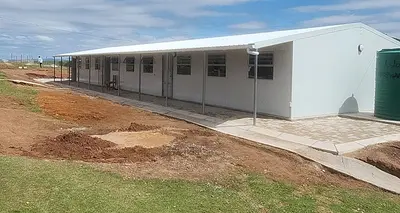
The South African department of education has delivered temporary classrooms to Ngoswana Primary School in Bhaziya, outside Mthatha, alleviating safety concerns for pupils and parents. The school, which was built in 1972, had been in a dilapidated state, with pupils as young as six being taught in half-collapsed classrooms. The temporary classrooms were delivered as part of the department's efforts to provide a safe teaching and learning environment.
Ngoswana Primary School was established by community members who wanted to provide a local education option for their children. Initially, the school had 103 pupils and consisted of two blocks with seven classrooms. However, over the decades, the school has been battered by extreme weather conditions, leaving it in a sorry state. Despite efforts by parents to maintain the school, with some contributing as little as R50 from their meagre social grants, the school's condition continued to deteriorate.
In March this year, the Daily Dispatch reported that pupils at Ngoswana Primary School were being taught in damaged and unsafe classrooms. The grade 1 pupils were being taught in a particularly hazardous classroom, and when it rained, pupils from different grades had to share classrooms. The situation was dire, with parents expressing concerns about the risk to their children's safety. The department of education has since taken steps to address the issue.
The department of education's spokesperson, Malibongwe Mtima, said the project to deliver temporary classrooms began in June and was completed on October 7. The project included the provision of temporary classrooms, installation of electricity, classroom boards, burglar bars, paving, verandahs, tiled floors, and fire extinguishers. Mtima said the department had reported the damage caused by severe weather in 2024 to the head office, but unfortunately, the disaster was not attended to due to budgetary constraints.
The delivery of temporary classrooms has brought relief to parents, who had been worried about the safety of their children. Nongejile Mfenguza, whose eight children attend the school, described the daily risks faced by the pupils. She expressed her gratitude for the temporary classrooms and pleaded for more permanent structures to be built. The school's SGB chair, Nocawe Mxinwa, said the parents were elated and hopeful that the enrolment numbers would improve now that the children have a safe place to study.
The temporary classrooms are yet to be used by the children, as an official handover is set for October 21. The school's learners are excited and eager to move into the new classrooms, particularly those in the lower grades. However, some parents are concerned that the older classrooms will still be in use, highlighting the need for further intervention. Community activist and ANC Youth League leader, Ndipiwe Makaula, commended the department for its efforts and emphasized the importance of protecting the infrastructure and increasing pupil numbers.
The community has welcomed the temporary solution, but there are hopes that a more permanent solution will be found. The school's enrolment numbers have been decreasing over the years due to its poor condition, but with the new classrooms, there is optimism that numbers will improve. The department of education has an obligation to provide a safe teaching and learning environment, and the delivery of temporary classrooms is a step in the right direction.
Key points
- The South African education department has delivered temporary classrooms to Ngoswana Primary School.
- The school had been in a dilapidated state, with pupils being taught in half-collapsed classrooms.
- The temporary classrooms are part of efforts to provide a safe teaching and learning environment.