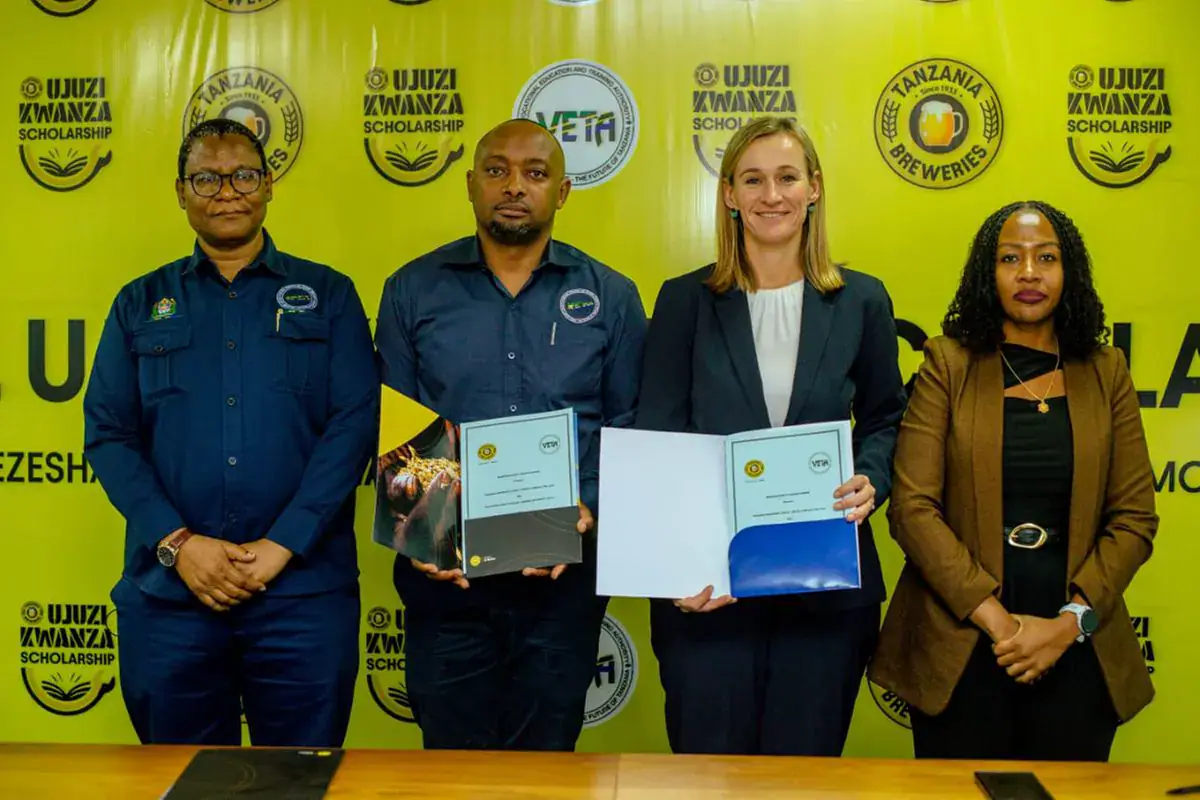
Tanzania Breweries Plc (TBL) has partnered with the Vocational Education and Training Authority (VETA) to train 300 young Tanzanians in practical agricultural skills. The Ujuzi-Kwanza Scholarship Programme is a three-year initiative aimed at improving employability and promoting entrepreneurship among young people from low-income households. The programme will provide training in agricultural production, equipment maintenance, agricultural mechanics, and other technical skills along the agricultural value chain.
Under the partnership, TBL will cover training fees, while VETA will provide accredited training, technical expertise, and nationally recognised qualifications. Participants will gain practical experience in agricultural operations and services, including opportunities within TBL’s barley and sorghum farming communities. The agreement was signed by TBL managing director Michelle Kilpin and VETA director general Anthony Kasore.
The partnership aims to address the growing demand for skilled workers as the agricultural sector modernises. According to VETA director general Anthony Kasore, the sector needs skilled young people who can support agricultural production, improve farming practices, maintain equipment, and provide essential technical services. Agriculture contributes 26.3 percent of Tanzania’s national output and employs more than half of the country’s working population.
The programme will create opportunities for employment and entrepreneurship while supporting agricultural productivity and livelihoods. TBL managing director Michelle Kilpin said investing in practical agricultural training would benefit young people and strengthen the supply chains that support TBL’s business. The initiative comes as more than 800,000 young Tanzanians enter the labour market annually.
VETA’s latest tracer study found that 75 percent of its graduates were employed or self-employed, with self-employment accounting for a greater share than formal paid employment. The partnership builds on TBL’s relationship with Tanzanian farmers, which dates back to 1933. The company purchases barley and sorghum from over 2,500 smallholder farmers in Arusha, Kilimanjaro, Manyara, and Dodoma regions.
The initiative aligns with Tanzania Development Vision 2050, Agenda 10/30, which targets annual agricultural growth of 10 percent by 2030, and the Building a Better Tomorrow programme, which promotes youth participation in agribusiness. VETA is also expanding access to vocational training, with enrolment rising from 69,347 students in the 2022/23 academic year to 116,468 in 2025/26.
Another 65 colleges are expected to open in January 2027, and collaboration with industry will help bridge the gap between training institutions and labour market needs. TBL and VETA plan to track graduates’ progress to assess the programme’s impact. The programme’s success will ultimately be measured by the opportunities it creates for beneficiaries, with the aim of seeing young Tanzanians turn practical skills into meaningful careers and sustainable livelihoods.
Key points
- TBL and VETA partner to train 300 young Tanzanians in agricultural skills under a three-year scholarship programme.
- The programme aims to address the growing demand for skilled workers in the modernising agricultural sector.
- The initiative aligns with Tanzania’s development vision and agenda to promote youth participation in agribusiness.