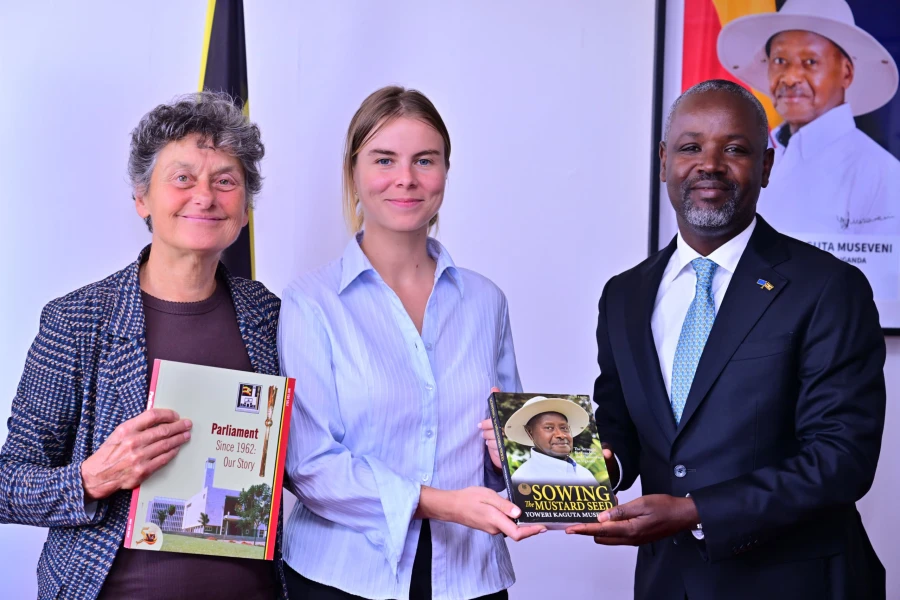
Deputy Speaker of Parliament, Rt. Hon. Thomas Tayebwa, has called on the European Union (EU) to increase and sustain funding for Uganda's refugee response. He made the appeal on Monday when receiving Members of the European Parliament, Hon. Tineke Strik and Hon. Anna Strolenberg, at Parliament. The EU delegation visited Uganda to understand the country's refugee policies and explore ways to strengthen cooperation in refugee management and humanitarian response.
Uganda's refugee response faces a significant financing gap, with the 2026 refugee response plan requiring approximately $850 million. However, only about 12 percent of the required funding has been provided by international partners. Tayebwa warned that the shortfall affects the capacity of government and humanitarian agencies to maintain essential services for refugees and Ugandan host communities.
The impact of reduced funding is being felt in refugee-hosting areas, where health, education, and public services are under pressure. Reductions in teachers and health workers supported by international partners have occurred, and staffing within the Department of Refugees under the Office of the Prime Minister has come under pressure. Tayebwa stated that the current humanitarian funding model is no longer sufficient.
Despite financial difficulties, Uganda will continue to receive people fleeing armed conflicts and insecurity in neighboring countries. Tayebwa described Uganda's refugee policy as anchored in humanitarian principles, emphasizing that the inability to fully finance refugee services does not indicate a lack of willingness to accommodate people escaping violence and persecution.
Uganda hosts over two million refugees and asylum-seekers, including large numbers of women and children, primarily from South Sudan and the Democratic Republic of Congo. Tayebwa called for international assistance to support both refugees and host communities, highlighting the implications of continued refugee arrivals for Uganda's humanitarian system and districts providing land and public infrastructure.
Beyond humanitarian financing, Tayebwa urged the EU and other international partners to invest in addressing conflicts driving displacement. He argued that humanitarian interventions alone cannot permanently resolve the refugee crisis if underlying causes remain unresolved. Resolving conflicts in neighboring countries would reduce pressure from new refugee arrivals and allow displaced populations to return home or rebuild their lives.
Tayebwa emphasized the need for predictable and long-term financing for the refugee response, appealing to European partners to maintain their support for Africa despite competing priorities. He described the refugee situation as an opportunity to deepen cooperation between Africa and Europe, strengthening their relationship at a time when international relations and multilateral cooperation face challenges.
Key points
- The European Union has been a dependable development and humanitarian partner for Uganda.
- Uganda's 2026 refugee response plan requires approximately $850 million.
- The country hosts over two million refugees and asylum-seekers, primarily from South Sudan and the Democratic Republic of Congo.