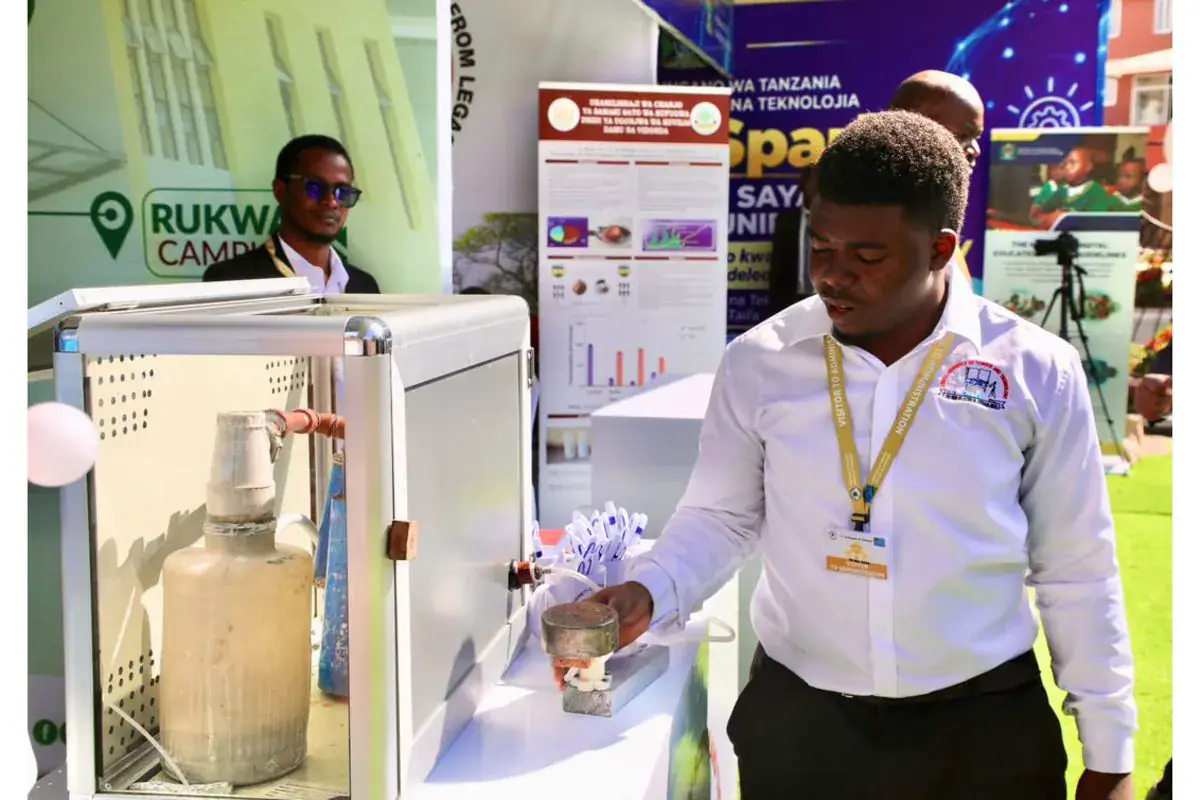
A student innovator from Mbeya University of Science and Technology (MUST) has developed a groundbreaking machine that uses water to produce hydrogen gas for cooking. The technology, known as the Atlas Hydrogen Reactor, was showcased at the Science, Technology and Innovation Exhibition held at the Parliament grounds in Dodoma on Wednesday, November 4, 2026. This innovation aims to reduce dependence on imported energy sources, particularly cooking gas and other fuels, whose prices are influenced by developments in international markets.
The inventor of the Atlas Hydrogen Reactor, Mr. Lusano Luvanda, from MUST’s Innovation and Technology Transfer Centre, explained that the machine separates hydrogen and oxygen from water, then purifies and cools the hydrogen for use as cooking fuel. This process allows for the production of hydrogen gas using locally available materials, making it a cost-effective and sustainable solution. By utilizing local resources, the innovation reduces reliance on imported energy sources and their associated price fluctuations.
According to Mr. Luvanda, the machine is still undergoing tests, with plans to officially introduce it to the market in December this year. The estimated operating costs of the machine range between Sh18,000 and Sh20,000 a month, making it a potentially affordable option for households. Additionally, the system generates hydrogen on demand rather than storing it in cylinders, reducing the risks associated with gas leaks from conventional cylinders.
One of the significant benefits of the Atlas Hydrogen Reactor is its ability to produce oxygen as a byproduct of the separation process. This oxygen can be collected and used in healthcare services, including supporting patients who require oxygen. This feature has the potential to positively impact the healthcare sector and improve patient care.
Another innovator, Hosea Kimaro, director of Honic Company, showcased practical learning equipment for science and technology subjects. His company manufactures devices that can teach multiple topics using a single device, reducing the costs schools incur when buying teaching materials. For example, the All in One Kit teaches electricity and combines functions that would otherwise require several devices.
Mr. Kimaro stated that the equipment developed by his company is already being used in schools and institutions in Dar es Salaam, Morogoro, Arusha, and Moshi, with plans to expand distribution to other parts of the country. The goal is to make these devices more accessible and reduce costs so that schools can purchase them collectively and enable more students to access practical learning opportunities.
Speaker of the National Assembly Mussa Zungu emphasized the need for increased investment in empowering young people economically and socially so they can turn their innovations into viable businesses. He stressed that young people require access to capital, land, and other resources to establish and expand income-generating activities, rather than facing limited economic opportunities.
Key points
- The Atlas Hydrogen Reactor offers a cost-effective and sustainable solution for cooking, with estimated operating costs between Sh18,000 and Sh20,000 a month.
- The machine produces oxygen as a byproduct, which can be used in healthcare services.
- The innovation aims to reduce dependence on imported energy sources and their associated price fluctuations.