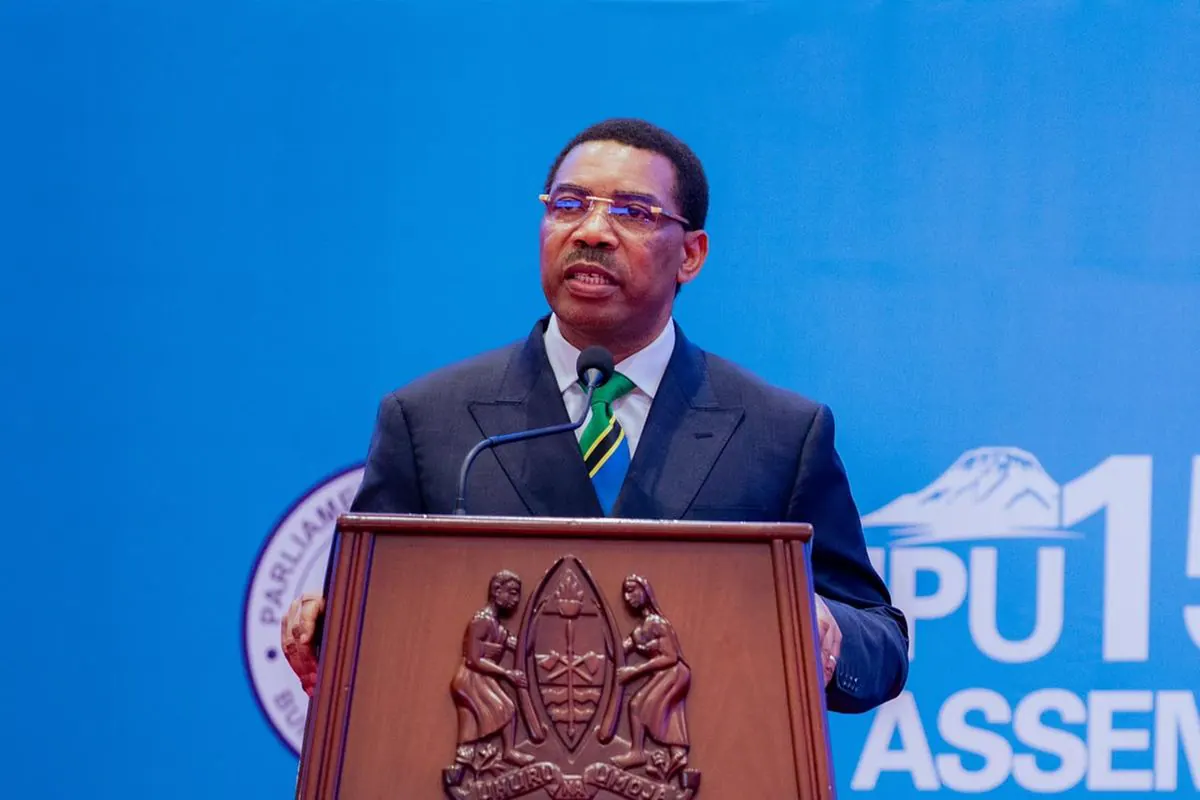
Tanzania's Prime Minister Mwigulu Nchemba has called for stronger international cooperation, dialogue, and inclusive development to address global challenges. He made the call when officially opening the 153rd Assembly of the Inter-Parliamentary Union (IPU) in Arusha on behalf of President Samia Suluhu Hassan. The assembly, being held from October 5 to 9, has brought together parliamentarians and parliamentary leaders from around the world to discuss strengthening good governance, inclusion, trust, and opportunities for all.
Dr Nchemba emphasized that Tanzania's commitment to the IPU is rooted in the belief that Parliament should serve as a cornerstone of peace, development, democracy, and the wellbeing of citizens. He noted that Tanzania has maintained its relationship with the IPU for more than six decades, having joined the organisation in 1962 as Tanganyika. The Prime Minister said Tanzania continues to promote peace, human rights, democracy, good governance, and inclusive development while responding to emerging challenges such as climate change, gender equality, and youth development.
Dr Nchemba highlighted the importance of Parliament in ensuring that public institutions remain accountable and responsive to citizens. He pointed to the constitutional role of Tanzania's Controller and Auditor General (CAG), whose reports are submitted to Parliament for scrutiny. The government has continued to strengthen the office through increased resources, with over Sh132 billion allocated to the CAG's office in the current financial year.
However, Dr Nchemba broadened the message beyond Tanzania, telling delegates that challenges facing societies are increasingly crossing borders and cannot be addressed by individual countries. He cited lessons from the Covid-19 pandemic, climate change, and conflicts in Eastern Europe as evidence of the need for countries to work together rather than respond through competition or confrontation.
IPU President Dr Tulia Ackson warned that exclusion and growing inequality are undermining trust in institutions and widening the distance between citizens and those who govern them. She said the global parliamentary community has gathered at a time when wars are destroying lives, respect for human rights is under pressure, the climate crisis is intensifying, and new technologies are developing faster than governments can regulate them.
Dr Ackson emphasized that good governance should be understood as an effort to close the gap between those who are included in decision-making and those who feel left outside. She called for greater participation by young people, persons with disabilities, and marginalised groups, saying their involvement should not be treated as a formality. Their participation could influence both public debate and decisions, making inclusion an essential part of meaningful parliamentary democracy.
IPU Secretary-General Ambassador Anda Filip placed parliamentary diplomacy, inclusive parliaments, and accountability at the centre of the organisation's new strategy for 2027-31. The strategy has three key objectives: building strong and inclusive parliaments, facilitating parliamentary diplomacy and joint action, and further strengthening the IPU as a responsible and accountable institution.
Key points
- Tanzania's Prime Minister Mwigulu Nchemba calls for stronger international cooperation to address global challenges.
- IPU President Dr Tulia Ackson warns of growing inequality and exclusion undermining trust in institutions.
- The 153rd IPU Assembly in Arusha aims to strengthen good governance, inclusion, trust, and opportunities for all.