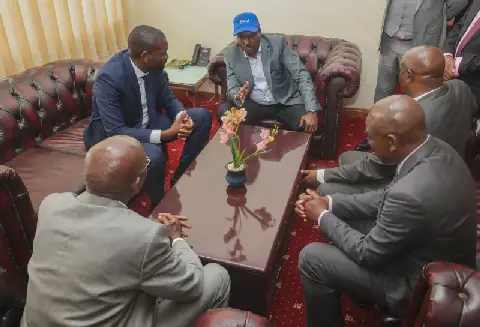
As Tanzania prepares to host the 2027 Africa Cup of Nations finals, a crucial question arises: what kind of football nation does Tanzania want to become after the tournament? This question gained significance following the recent visit of Confederation of African Football (CAF) President Patrice Motsepe to the Benjamin Mkapa Stadium in Dar es Salaam. During the visit, Prime Minister Mwigulu Nchemba assured CAF that Tanzania is on track with its preparations, with the remaining work on stadiums and infrastructure to be completed by December.
Prime Minister Nchemba's message went beyond the physical preparations for the tournament, emphasizing Tanzania's ambition to prepare a competitive national team, Taifa Stars, capable of performing strongly on the continental stage. This ambition is crucial, as hosting AFCON successfully requires not only quality stadiums and infrastructure but also a national team that can carry the country's hopes. Nchemba's reference to producing a player like Siphiwe Tshabalala, who scored a memorable goal for South Africa at the 2010 World Cup, was a call to action for Tanzania to develop its own football stars.
The Prime Minister's emphasis on building a strong national team is a significant shift in Tanzania's football strategy. Currently, the country has a passionate fan base, with the Simba-Yanga rivalry generating enormous interest in domestic football. However, the challenge is to convert this passion into sustained support for Taifa Stars and, ultimately, into a stronger football economy. A host nation carries a special burden of expectation, and Taifa Stars will not simply be playing for points but will be carrying the hopes of millions of supporters.
To achieve this goal, Tanzania needs to identify talent early, develop depth in every position, give emerging players meaningful international experience, and establish a clear footballing identity. This requires a longer-term national football development programme, rather than a short-term campaign built around 2027. CAF inspections are necessary to ensure that Tanzania meets the standards required for a major tournament, but the country needs a national team capable of competing with Africa's established football powers.
The Benjamin Mkapa Stadium in Dar es Salaam is one of Tanzania's most important football venues, and infrastructure development in Arusha adds another important dimension to the country's preparations. However, Tanzania's football history will not be written in project plans or inspection reports but on the pitch, when a player scores a goal that an entire country remembers or when a team produces a performance that captures the imagination of its supporters.
With time still available before the tournament, Tanzania has the opportunity to build a team capable of handling the pressure that comes with being a host nation. This involves identifying weaknesses, developing alternatives, and giving younger players opportunities. The challenge is to ensure that when AFCON 2027 arrives, the country is not merely ready to host Africa but is ready to show Africa what Tanzanian football can become.
Ultimately, if Tanzania gets its football development right, the 2027 Africa Cup of Nations could leave behind something far more valuable than refurbished stadiums – it could leave behind a stronger football system. This would be a lasting legacy for Tanzanian football, and the country now has the opportunity to create memories on home soil that will survive long after the final whistle.
Key points
- Tanzania aims to develop a competitive national team, Taifa Stars, capable of performing strongly in the 2027 Africa Cup of Nations.
- The country needs a longer-term national football development programme to build a strong football system.
- Tanzania's football history will be written on the pitch, with memorable performances and goals that capture the imagination of its supporters.