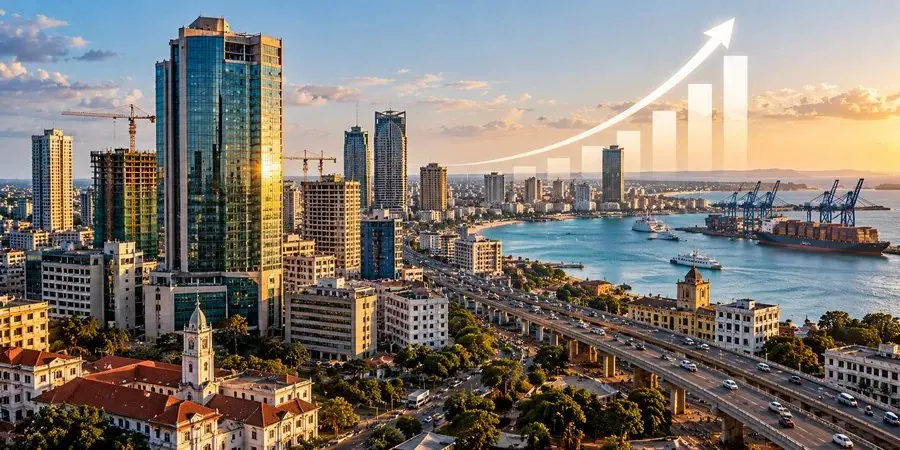
The World Bank has upgraded Tanzania's growth forecast to 6.1% for 2026, citing a strong investment case across infrastructure, energy, and private-sector activity. This upward revision is based on the country's GDP growth of 5.9% in 2025, as recorded by the World Bank. The bank now projects Tanzania's expansion to reach an average of 6.5% over the medium term, driven by sustained fiscal discipline and structural reforms that improve the business environment.
The World Bank attributes the acceleration in growth to stronger private-sector activity, supported by growth-supporting fiscal consolidation. The 2025 expansion was driven by a services recovery, infrastructure investment, and a gradual rebound in private capital flows. Tanzania has invested heavily in transport, energy, and digital infrastructure in recent years, which has contributed to the growth momentum. The government has also courted foreign direct investment to widen the capital base, supporting the 2025 result.
Macroeconomic stability has added another layer of confidence, with inflation remaining within the Bank of Tanzania's target range. This has anchored real returns for domestic and international investors alike, with transport, logistics, energy, and digital services standing to benefit from continued productivity gains. However, the World Bank stresses that headline growth alone will not determine investment returns, and Tanzania must improve public spending quality and direct capital towards job creation.
Human capital remains central to the medium-term story, with better education, healthcare, and skills training needed to lift productivity and raise wage levels. As a result, consumer markets will deepen alongside infrastructure expansion. The World Bank's forecast gives investors a clear benchmark for assessing policy execution, with fiscal discipline being a key factor. Delayed reforms could weaken confidence and slow the pace of expansion.
External cost pressures, including elevated energy prices, pose a secondary consideration for Tanzania's growth trajectory. Geopolitical disruptions can also raise transport costs and complicate supply chains. Climate risk is material, with droughts and floods able to disrupt agriculture, damage infrastructure, and compress rural incomes. These risks highlight the value of resilient logistics networks and diversified supply arrangements.
On the policy side, Tanzania and Qatar signed a double-taxation avoidance agreement on 29 September 2026, targeting cross-border investment flows and tax certainty for businesses operating across both jurisdictions. The deal awaits ratification before taking effect. The agreement is seen as a positive step towards creating a more favorable business environment.
The World Bank's 6.5% medium-term projection for Tanzania rests on reform delivery, not projections alone. The country that executes on fiscal consolidation, infrastructure spend, and human-capital investment will attract deeper pools of private finance. Investors and policymakers should closely watch fiscal execution, private-credit growth, energy costs, and infrastructure delivery through the remainder of 2026.
Key points
- The World Bank projects Tanzania's GDP growth to reach an average of 6.5% over the medium term.
- Tanzania's growth acceleration is driven by stronger private-sector activity and growth-supporting fiscal consolidation.
- The country must improve public spending quality and direct capital towards job creation to achieve sustainable growth.