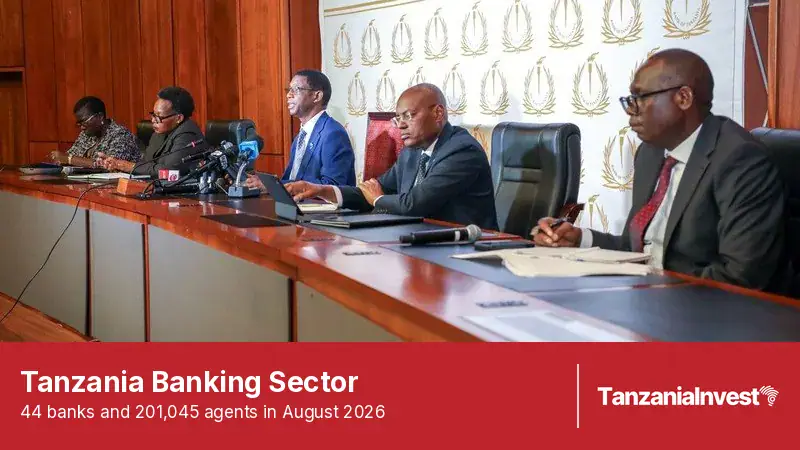
The banking sector in Tanzania has shown significant growth, with 44 banks operating in the country as of August 2026. These institutions comprise 35 commercial banks, five microfinance banks, two community banks, and two development banks. According to the Bank of Tanzania (BoT), the sector also has 1,095 branches and 201,045 agents. This information was published in the sixth issue of Uchumi Wetu, BoT's quarterly magazine, which was listed on the central bank's website on 16 October 2026.
The distribution of bank branches across the country varies, with Dar es Salaam having the highest number at 280, accounting for about 26% of the national total. Other regions with a significant number of branches include Mwanza with 72, Arusha with 71, Dodoma with 52, and Kilimanjaro with 48. The BoT also reported that the sector's core capital stood at 17.86%, above the statutory minimum of 10%, while total capital was 19.16% against a minimum of 12%.
The liquidity ratio of the banking sector was 26.05%, surpassing the statutory minimum of 20%. Additionally, non-performing loans accounted for 2.50% of total loans, which is below the 5% benchmark cited by the BoT. The return on assets was 4.68%, and the return on equity was 22.26% at August 2026. These indicators suggest that the banking sector is performing well and is capable of withstanding challenges.
The banking sector's performance is also reflected in the growth of loans, loan guarantees, and overdraft accounts, which reached TZS 57.09 trillion (± USD 21.68 billion) at June 2026. This represents a 32.27% increase from TZS 43.16 trillion (± USD 16.39 billion) at June 2025. Most of this credit was directed to key sectors such as trade, industry, agriculture, construction, communications, and transport.
According to the BoT's Financial Sector Supervision Directorate, the capital and liquidity ratios indicate that banks can meet customers' cash requirements and other obligations. However, the directorate also noted that the increasing use of digital platforms, mobile banking, artificial intelligence, and cloud systems is changing service delivery and creating new risks, such as cybersecurity and customer-data risks, which require closer supervision.
The banking sector dominates the financial sector, accounting for more than 70% of financial-sector assets. Outside the banking sector, the microfinance sector is also significant, comprising 3,229 credit-only institutions, 1,030 savings and credit cooperative societies (SACCOS), and 81,878 community groups providing financial services. These institutions play a crucial role in providing financial services to a wider range of people.
The growth and performance of the banking sector in Tanzania are promising, with strong capital and liquidity ratios, and an increasing outreach through agents and digital platforms. However, the sector also faces new challenges, such as managing cybersecurity risks and providing services to a wider range of customers. The BoT's Financial Sector Supervision Directorate will continue to monitor the sector and ensure that banks operate in a safe and sound manner.
Key points
- The banking sector in Tanzania has 44 banks, 1,095 branches, and 201,045 agents as of August 2026.
- The sector's capital and liquidity ratios are strong, with core capital at 17.86% and liquidity at 26.05%.
- The banking sector accounts for more than 70% of financial-sector assets in Tanzania.
Reporting sources
- Tanzania Banking Sector Has 44 Banks and 201,045 Agents in August 2026 · tanzaniainvest.com