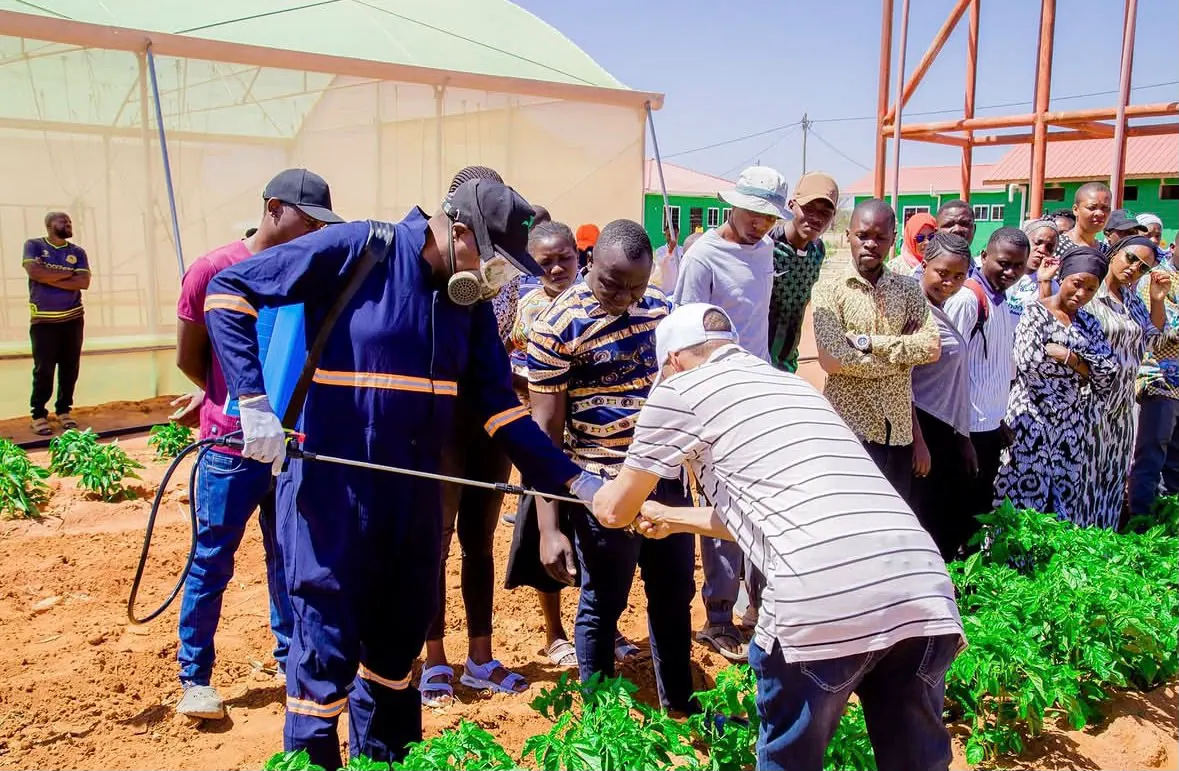
Tanzania's agricultural sector has evolved from a subsistence activity into a strategic commercial powerhouse, positioning the nation as East Africa's premier food basket. Under President Dr. Samia Suluhu Hassan's leadership, the sectoral budget has increased from 294bn/- in 2021/22 to a record 1.105tri/- in 2026/27. This significant investment has enabled the government to fund irrigation schemes, infrastructure development, and subsidize inputs. As a result, food crop production reached 23.78 million tonnes in the 2024/25 season, achieving a national food self-sufficiency ratio of 130 per cent.
The country's agricultural sector currently contributes 26.3 per cent of Tanzania's GDP and employs 61.4 per cent of the national workforce, while accounting for 23.6 per cent of the country's exports of goods. With ambitious targets of 10 per cent annual growth by 2030 and 3 billion US dollars in agro-processing value, Tanzania is attracting global investors through initiatives like the Agricultural Growth Corridors of Tanzania (AGCOT). AGCOT targets 100 billion US dollars in agricultural GDP by 2050 and represents a systems-level transformation of the sector.
The AGCOT initiative, launched in 2025, aims to quintuple Tanzania's agricultural GDP, reshape the entire agricultural sector, and ensure benefits reach every Tanzanian, especially women and youth. AGCOT Centre CEO Geoffrey Kirenga stated that Tanzania is building institutional foundations for a transformation that will have a significant impact on the sector. The initiative builds on SAGCOT's success, which attracted 6.34 billion US dollars in investments over 14 years.
Minister for Agriculture Daniel Chongolo assured farmers that there is no need to fear the availability or supply of fertilizer, as the government has plenty of stock in its warehouses. The government fertilizer subsidy program, launched five years ago, will continue to enable increased food and cash crop output. Tanzania offers vast untapped opportunities, with 44 million hectares of arable land, yet only 10.8 million hectares (24 per cent) are currently under cultivation.
The government is turning farming into an investment-ready sector, with Minister of State in the President's Office for Planning and Investment Prof Kitila Mkumbo detailing how bilateral agreements cover agriculture, industries, transport, logistics, trade, and investment. These strategic MoUs are part of the active implementation process to open up Tanzania to global powers, ensuring the agricultural revolution is backed by solid international capital.
Key investment areas in Tanzania include commercial farming across 33.2 million hectares of uncultivated arable land, offering scale rarely available elsewhere. Major food crops include maize, rice, pulses, bananas, and cassava, while cash crops include cashew nuts, coffee, cotton, tea, tobacco, and sisal. Agro-processing aligns with the Master Plan 2030 target of 3 billion US dollars in processing value, with gaps across grain milling, edible oils, dairy, and horticulture.
The reforms are delivering tangible benefits, with average maize yields jumping from 1.5 to 2.5 tonnes per hectare, doubling net household income for millions of rural families. The International Institute of Tropical Agriculture (IITA) Director General, Dr. Simeon Ehui, reflected that the focus on making agriculture attractive for youth, creating jobs, and empowering the next generation to thrive in agribusiness is exciting.
Key points
- Tanzania's agricultural sector has achieved a national food self-sufficiency ratio of 130 per cent.
- The Agricultural Growth Corridors of Tanzania (AGCOT) initiative targets 100 billion US dollars in agricultural GDP by 2050.
- Tanzania aims to achieve 10 per cent annual growth in the agricultural sector by 2030.