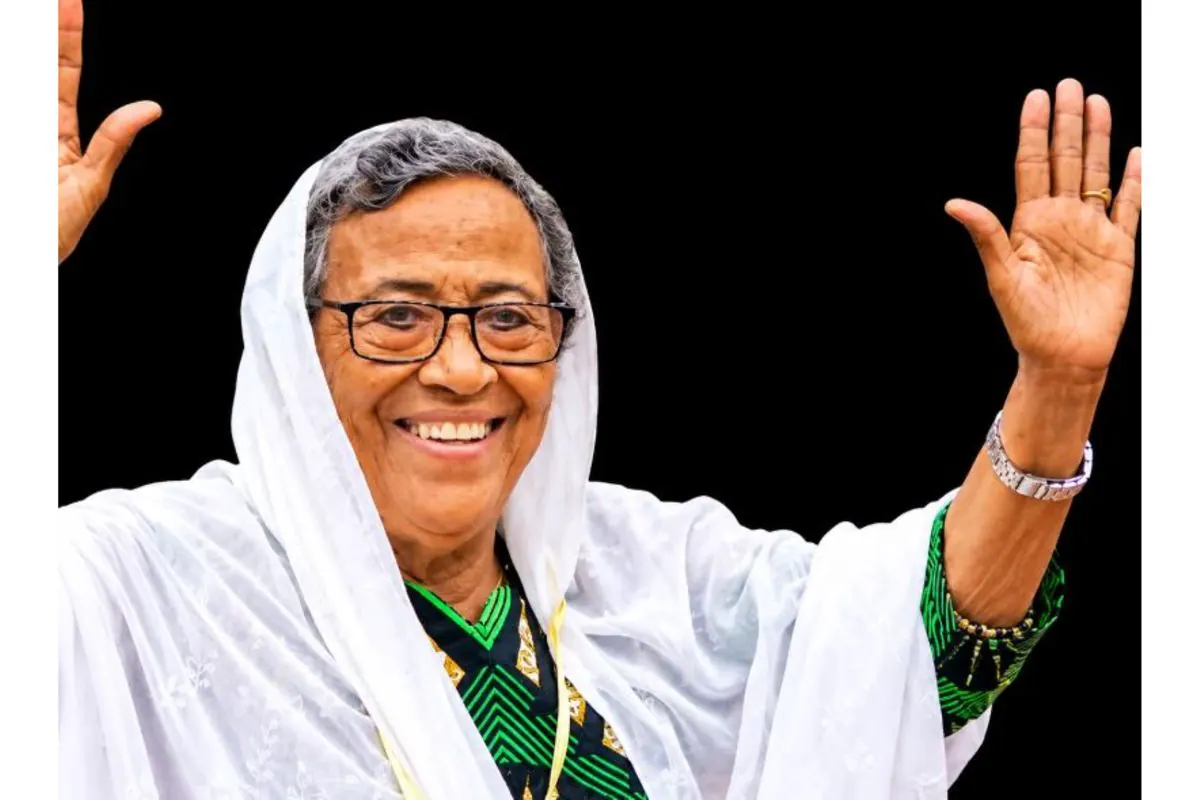
Zanzibar President Dr. Hussein Ali Mwinyi led hundreds of mourners at the funeral of Fatma Karume, held at the Karume family cemetery in Mbweni, Urban West Region. The ceremony was attended by prominent government and political leaders, including Zanzibar's First Vice President Othman Masoud Othman and Second Vice President Hemed Suleiman Abdulla. Fatma Karume, born on February 2, 1929, in Bumbwini, North Unguja, was a trailblazer in Zanzibar's history.
Fatma Karume was born Fatma Ghulam Hussein Jamal and received her basic Islamic education through madrasa studies in Bumbwini. She was married to Abeid Amani Karume, Zanzibar's first president and chairman of the Revolutionary Council. The couple had three children: Asha Abeid Karume, who predeceased her mother, Amani Abedi Karume, and Ali Abeid Karume. Karume was devoted to her family, actively caring for her children, grandchildren, and great-grandchildren.
Before the Zanzibar Revolution of January 12, 1964, Fatma Karume joined her husband in mobilizing women to demand the right to self-determination. She served as secretary of a women's group that campaigned for women's right to vote. After the Revolution, she became a leader of the women's wing of the Afro-Shirazi Party (ASP), advocating for women's economic empowerment and better family welfare.
Fatma Karume was regarded as a living repository of Zanzibar's history, including the Revolution, the Union between Tanganyika and Zanzibar, and the politics of the ASP and CCM. She was known for her cheerful and warm-hearted nature, interacting with people from all walks of life without discrimination. Karume was involved in various business and investment activities, supporting culture and football, and served as a patron and chairperson of the Young Africans Sports Club Board of Trustees.
Ambassador Ali Karume recalled that his mother was the first woman to demand women's right to vote. She presented her demand to British official James Johnson, with Abdalla Mzee serving as their interpreter. Fatma Karume argued that if men could vote, women should also have the right. This led to women being granted equal voting rights with men in the 1961 and 1963 elections.
Fatma Karume received various awards and honors, including the Revolutionary Medal for a Distinguished Leader, in recognition of her contributions to society. Her life has left a legacy of patience and distinguished service to the people of Zanzibar and Tanzania. Her activism paved the way for women to hold senior leadership positions, including ministerial and ambassadorial posts.
President Mwinyi and other leaders have praised Fatma Karume's vision and legacy, highlighting her role in shaping Zanzibar's history and promoting women's empowerment. Her passing has sparked an outpouring of tributes, with many acknowledging her tireless efforts to improve the lives of women and her contributions to Tanzania's development.
Key points
- Fatma Karume was a pioneering figure in Zanzibar's history, championing women's rights and playing a pivotal role in the country's revolution.
- She was a devoted family woman, actively caring for her children, grandchildren, and great-grandchildren.
- Karume's legacy continues to inspire women to hold senior leadership positions in Tanzania.