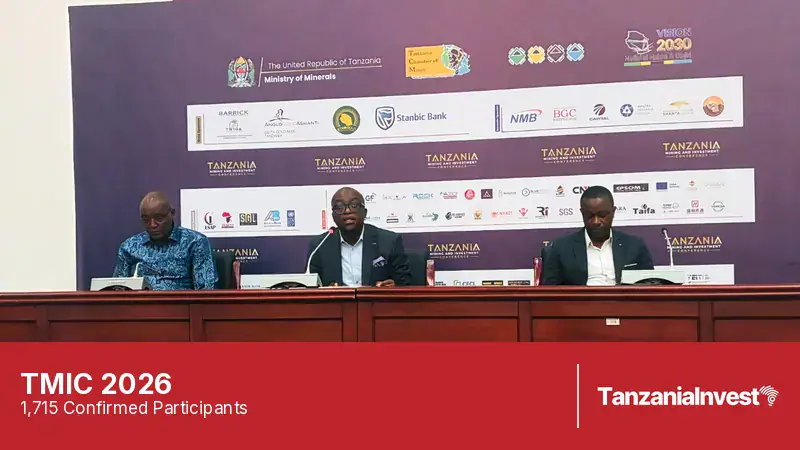
The Tanzania Mining and Investment Conference 2026 (TMIC) has confirmed 1,715 participants as of 17 November, according to Minister of Minerals Anthony Mavunde. The conference, set to take place at the Julius Nyerere International Convention Centre (JNICC) in Dar es Salaam, will feature 226 participants from outside Tanzania and over 57 speakers. The event aims to promote value-added minerals as a key driver of industrial and economic growth.
High-profile attendees include President Samia Suluhu Hassan, who is scheduled to open the seventh edition on 19 November, and Zanzibar President Hussein Ali Mwinyi, who will close the conference on 21 November. Prime Minister Mwigulu Lameck Nchemba will attend the Mining Gala Night on 20 November as the guest of honour. The conference programme includes ministerial side meetings, business-to-business meetings, and an exhibition showcasing the supply chain from extraction to finished products.
The conference theme, “Value-Added Minerals: The Engine of Industrial and Economic Growth,” reflects Tanzania’s focus on domestic processing. Since the 2017 mining reforms, the country has made significant progress, including the establishment of eight gold refineries and over 16 mineral processing plants under construction. These projects mainly focus on copper and nickel, with a plant producing copper cathodes at Nala in Dodoma and small operators installing copper processing equipment in Katavi.
Minister Mavunde highlighted several development projects, including the relocation of Songwe Prison for a niobium mining and processing project in Mbeya Rural District. Additionally, a mineral separation plant in Pangani District will process heavy mineral sands from Tanzania, South Africa, and Madagascar. The government is also constructing processing plants in the Kahama Special Economic Zone and a gemology centre in Arusha to train young people in gemstone cutting and polishing.
To support small-scale miners, the government has improved access to primary mining licences and provided subsidized drilling services through STAMICO. The Geological Survey of Tanzania (GST) and STAMICO are using drones and magnetometers to help miners identify promising areas before drilling. A credit guarantee scheme launched on 1 July 2026 aims to help small-scale miners borrow funds to purchase equipment.
The mining sector has contributed significantly to Tanzania’s economy, accounting for 10.3% of mainland Tanzania’s gross domestic product in 2025, up from 7.8% in 2024. Mineral exports rose from USD 4.12 billion to USD 5.40 billion over the same period. Government revenue from mining reached TZS 1.39 trillion (± USD 525.2 million) in 2025/26, up from about TZS 526 billion (± USD 198.7 million) in 2020/21.
The sector also supports 19,874 formal jobs as of April 2025, with 97.4% held by Tanzanians. Sector purchases of goods and services rose from TZS 884.09 billion (± USD 334.0 million) in 2010 to TZS 5.2 trillion (± USD 1.96 billion) in 2025. Small-scale miners account for about 40% of national mineral production, and the government has signed mining framework agreements with 14 joint venture companies to develop various mineral projects.
Key points
- The Tanzania Mining and Investment Conference 2026 has confirmed 1,715 participants, including 226 from outside Tanzania.
- The conference aims to promote value-added minerals as a key driver of industrial and economic growth.
- Tanzania’s mining sector has seen significant growth, with mineral exports rising from USD 4.12 billion to USD 5.40 billion between 2024 and 2025.