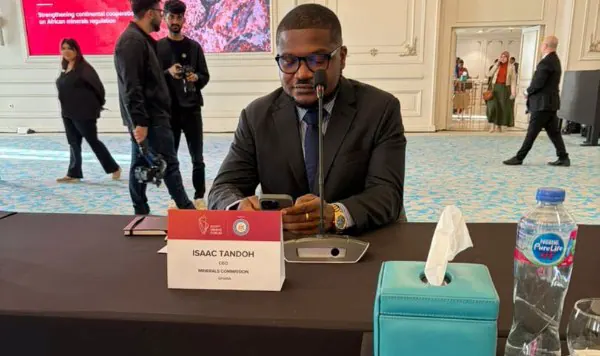
Ghana's Minerals Commission CEO Isaac Tandoh has proposed a Pan-African Critical Minerals Charter to unify mining regulations across the continent. Speaking at the Egypt Mining Forum in Cairo on September 27, 2026, Tandoh argued that differences in national mining policies allow foreign companies to shop for weaker rules, undermining African governments and communities. He emphasized that Africa's mineral wealth is crucial for the continent's economic sovereignty and industrial future.
Tandoh's call for a unified charter comes as Ghana faces a mining permit scandal in the Ahafo Region. Only one of six foreign-owned mining firms operating in the region was found to hold a valid permit, with most unpermitted operations being Chinese-run. This regulatory gap illustrates the kind of exploitation that Tandoh warns against, with foreign operators taking advantage of weak national rules to minimize taxes, oversight, and other concessions.
The proposed Pan-African Critical Minerals Charter would require mining agreements to include conditions on local job creation, technology transfer, and investment in mining host communities. Tandoh also advocates for an end to automatic contract renewals and unmonitored privileges for mining companies. These reforms aim to ensure that African nations set the value of their resources according to domestic priorities, rather than allowing international markets to dictate terms.
In Ghana, the Minerals Commission is responsible for regulating and managing the country's mineral resources, including licensing mining operators and enforcing compliance. Tandoh outlined regulatory reforms underway in Ghana to increase state returns from mining, boost local value addition, and tighten environmental compliance. These reforms aim to address the specific permit gaps identified in the Ahafo Region and improve the overall regulatory framework.
The stakes of the debate are practical for ordinary Ghanaians, who may face lost tax revenue, weaker environmental and safety standards, and fewer guarantees of local jobs or benefits from mineral extraction. The recent deaths of two miners trapped in a Juaboso pit highlight the broader safety crisis in Ghana's small-scale and illegal mining sector, which is often linked to weak enforcement and regulatory patchwork.
While Tandoh's proposal has significant implications for Ghana and the continent, the timeline for drafting or adopting a Pan-African Critical Minerals Charter remains unclear. Neither Ghana's government nor the African Union has publicly indicated how or whether such a charter would be negotiated among member states. The Minerals Commission and other stakeholders will likely continue to engage on this issue in the coming months.
The push for a unified African mining charter reflects a broader effort to ensure that the continent's mineral wealth benefits local communities and governments, rather than just international markets. As Tandoh emphasized, Africa's mineral wealth is not just a commodity for global markets, but a key to the continent's economic sovereignty and industrial future. The outcome of this initiative will have significant implications for Ghana, Africa, and the global mining industry.
Key points
- Isaac Tandoh proposes a Pan-African Critical Minerals Charter to unify mining regulations across Africa.
- Ghana faces a mining permit scandal in the Ahafo Region, with only one of six foreign-owned firms holding a valid permit.
- The proposed charter aims to ensure that African nations set the value of their resources according to domestic priorities, rather than allowing international markets to dictate terms.