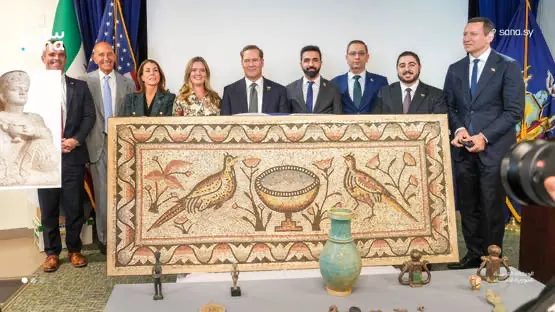
The Syrian government has successfully retrieved 36 stolen antiques from the United States, with a total value of over $5 million. The artifacts were returned to the Syrian embassy in Washington, DC, and include a large stone sculpture from the ancient city of Palmyra. The sculpture, which weighs over 450 kilograms, is a 2nd-century funerary monument featuring a man surrounded by a woman and three children.
The retrieved artifacts also include a 3rd-century BC mosaic depicting a mythological wedding between Telephus and Eros. The mosaic, which is a significant part of a larger floor mosaic, was stolen from a Roman villa in Syria along with 14 other exceptional pieces. US authorities have identified Lebanese smuggler George Lotfi as one of the individuals involved in the smuggling of the artifacts to New York.
The Palmyra sculpture was smuggled out of Syria in pieces to avoid damaging the figures, and then transported to Dubai and eventually to New York. The piece was likely sold on the black market, but US authorities were able to seize it as part of an investigation into antiquities trafficking. The return of the artifacts is a significant victory for Syria, which has suffered significant cultural losses due to the ongoing conflict.
Palmyra, a UNESCO World Heritage site, has been the target of extensive looting and destruction by the Islamic State (ISIS) between 2015 and 2017. The site is home to numerous ancient ruins, including the famous Palmyra temple and theater. The return of the artifacts is a welcome boost to Syria's cultural heritage, which has been severely impacted by the conflict.
In addition to the Palmyra sculpture and the Telephus and Eros mosaic, the retrieved artifacts include three 2nd-millennium BC Syrian female statues from northwest Syria. The statues are significant examples of ancient Syrian art and demonstrate the rich cultural heritage of the region. The return of the artifacts is a testament to the cooperation between US and Syrian authorities in combating antiquities trafficking.
The Syrian government has welcomed the return of the artifacts, which are expected to be put on display at the National Museum of Damascus. The retrieval of the artifacts is a significant achievement for the Syrian government, which has been working to recover stolen cultural heritage items. The incident highlights the need for continued cooperation between countries to prevent the looting and trafficking of cultural artifacts.
The value of the retrieved artifacts is estimated to be over $5 million, making it a significant recovery for Syria's cultural heritage. The incident also underscores the importance of protecting cultural heritage sites and preventing the looting and trafficking of artifacts.
Key points
- The retrieved artifacts include a large stone sculpture from Palmyra and a 3rd-century BC mosaic depicting a mythological wedding.
- The artifacts were smuggled out of Syria and sold on the black market, but US authorities were able to seize them as part of an investigation into antiquities trafficking.
- The return of the artifacts is a significant victory for Syria, which has suffered significant cultural losses due to the ongoing conflict.