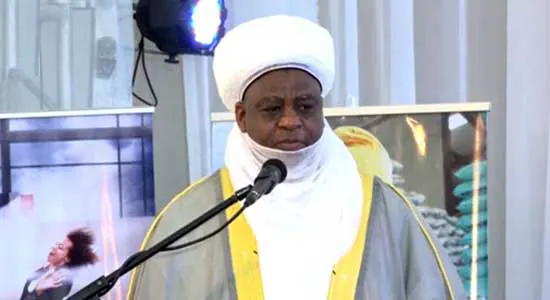
The Sultan of Sokoto, Alhaji Sa'ad Abubakar III, has urged politicians and public office holders to refrain from sponsoring pilgrimages to holy lands with stolen public funds. He made this statement at the opening ceremony of the stakeholders' meeting organised by the Nigeria Inter-Religious Council (NIREC) in Abuja. The Sultan emphasized the importance of collaboration between religious leaders and anti-corruption agencies to curb systemic graft.
The Sultan stressed that using stolen funds for pilgrimages is unacceptable in the eyes of God, stating that "God Almighty doesn't like corruption." He urged the Economic and Financial Crimes Commission (EFCC) to deal decisively with corrupt individuals, regardless of their political or religious affiliations. The Sultan also called for the EFCC to discharge its duties without political interference.
Abubakar praised NIREC as a unique platform for fostering dialogue between Christians and Muslims, highlighting the importance of national unity. He emphasized that genuine mutual understanding between religious leaders is essential for peace, stability, and national development. The Sultan urged religious leaders to prioritize understanding over mere tolerance.
The Sultan cautioned clerics to be mindful of their utterances from the pulpit, especially during election periods. He urged them to pray for national leaders rather than using religious platforms to incite division or attack public officers. Abubakar paid tribute to the outgoing Executive Secretary of NIREC, Prof. Cornelius Omonokhua, commending his eight-year tenure for transforming the council.
Prof. Adedibu Ojerinde, Chairman of the Interfaith Anti-Corruption Advisory Committee (IAAC), discussed the Interfaith Anti-Corruption Manuals Project. The project aims to mobilize the pulpit and minbar to transform public morality through dedicated preaching manuals anchored in biblical and Qur'anic texts. The manuals were originally inaugurated in 2014 and re-inaugurated in January 2024 by President Bola Tinubu.
Ojerinde said the manuals were expanded to address contemporary challenges, including youth, cybercrime, and money laundering vulnerabilities within religious institutions. He urged for the integration of anti-corruption themes into Friday sermons and Sunday messages. The formal handover of the manuals to NIREC marked a shift from publication to practical execution.
The opening ceremony was attended by Christian and Muslim leaders, government officials, security representatives, and the media. The Sultan's remarks and the presentation of the manuals underscored the importance of collaboration between religious leaders and anti-corruption agencies in the fight against corruption.
Key points
- The Sultan of Sokoto urges politicians to refrain from sponsoring pilgrimages with stolen public funds.
- The Interfaith Anti-Corruption Manuals Project aims to transform public morality through dedicated preaching manuals.
- The Sultan emphasizes the importance of national unity and genuine mutual understanding between religious leaders.