Sudanese visual artist Waleed Mohammed is using his art to document and reclaim his country's collective memory. Based in Nairobi, Kenya, Mohammed draws on his personal experience of war, displacement, and family dispersal to create artworks that explore the transformations in Sudanese lives since the outbreak of war in April 2023. His paintings are inspired by historical photographs and family albums, which he uses to reinterpret Sudan's visual memory in contemporary artistic forms.
Mohammed's relationship with painting began in childhood, and he went on to study fine art, specializing in the discipline. However, the outbreak of war in Sudan forced him to leave the country and continue his artistic career abroad. He moved to Nairobi, where he began a new chapter in his creative journey. Mohammed's work is inspired by the archives of Sudanese photographers, including Rashid Mahdi and Gadalla Gubara, as well as other photographic sources.
Mohammed's artistic approach engages with the concept of post memory, developed by Marianne Hirsch in her research on the children of Holocaust survivors. This concept describes the relationship of a later generation to a trauma they did not experience directly but which is transmitted through photographs, stories, and silence. Mohammed's work intersects with post memory approaches, but his experience as a witness to war and displacement gives his artistic experience its particular character.
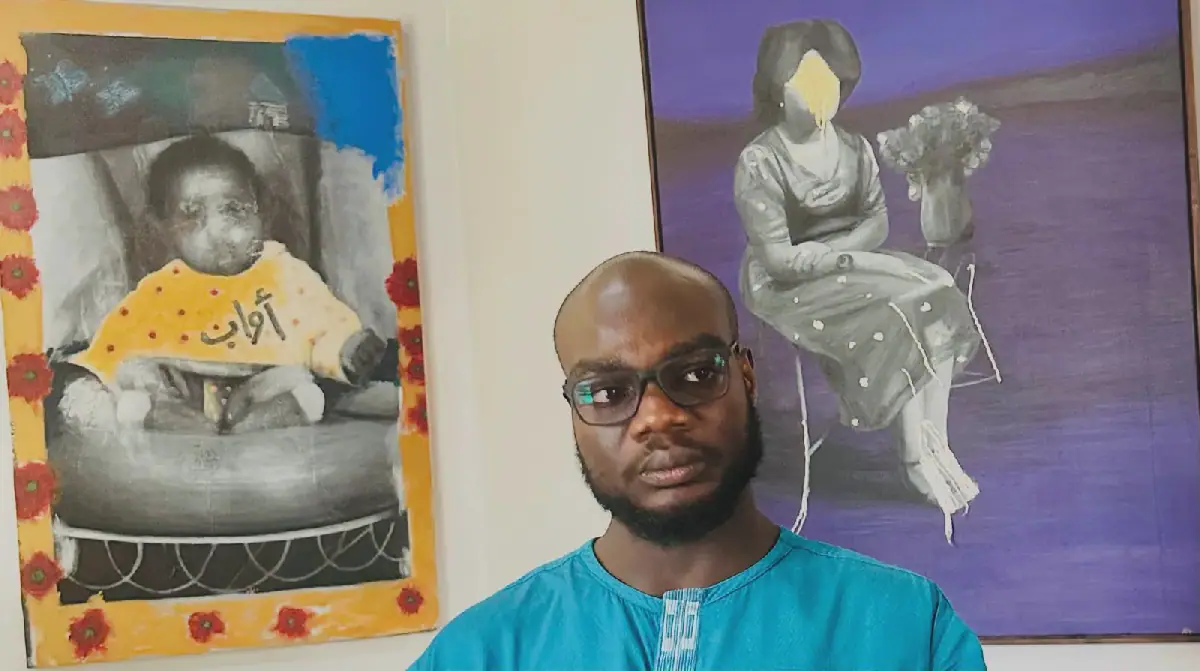
A striking duality of color characterizes Mohammed's work, with monochromatic grey bodies and faces evoking the fading and deterioration of photographs over time. His paintings also feature richly saturated fields of color, including deep indigo blue, crimson red, and earthy yellow. Faces become erased or obscured areas, conveying the fragility of memory and the loss of loved ones.
Mohammed's work includes a series called Spaces of Escape, which reflects the disruption the war has brought to people's lives and social relationships. The series features figures depicted with incomplete features or partially obscured faces, and makes extensive use of open spaces and empty areas. According to Mohammed, this artistic treatment reflects the forced migration and fragmentation that Sudan has experienced.
Mohammed's paintings also hold personal significance, with one work depicting his mother and another, entitled Something Special, based on a photograph by Rashid Mahdi. He describes the latter as one of the works that inspires him and gives him a sense of closeness to his heritage. Mohammed's artistic experience is deeply connected to his society, and people's suffering and transformations have become central subjects in his work.
Mohammed's artwork Awab illustrates his personal experience of the war and its impact on his family. The painting is named after his nephew, who is currently in Libya, and expresses Mohammed's desire to preserve his presence through the artwork despite the distances imposed by the war. Through this deeply personal experience, Mohammed seeks to express a much wider reality shared by Sudanese people separated by the conflict.
Key points
- Waleed Mohammed's artwork is inspired by historical photographs and family albums, which he uses to reinterpret Sudan's visual memory in contemporary artistic forms.
- Mohammed's artistic approach engages with the concept of post memory, developed by Marianne Hirsch in her research on the children of Holocaust survivors.
- Mohammed's work reflects the disruption the war has brought to people's lives and social relationships in Sudan, and his artistic experience is deeply connected to his society.
Reporting sources
- Waleed Mohammed: Using art to preserve Sudan’s collective memory · Radio Dabanga