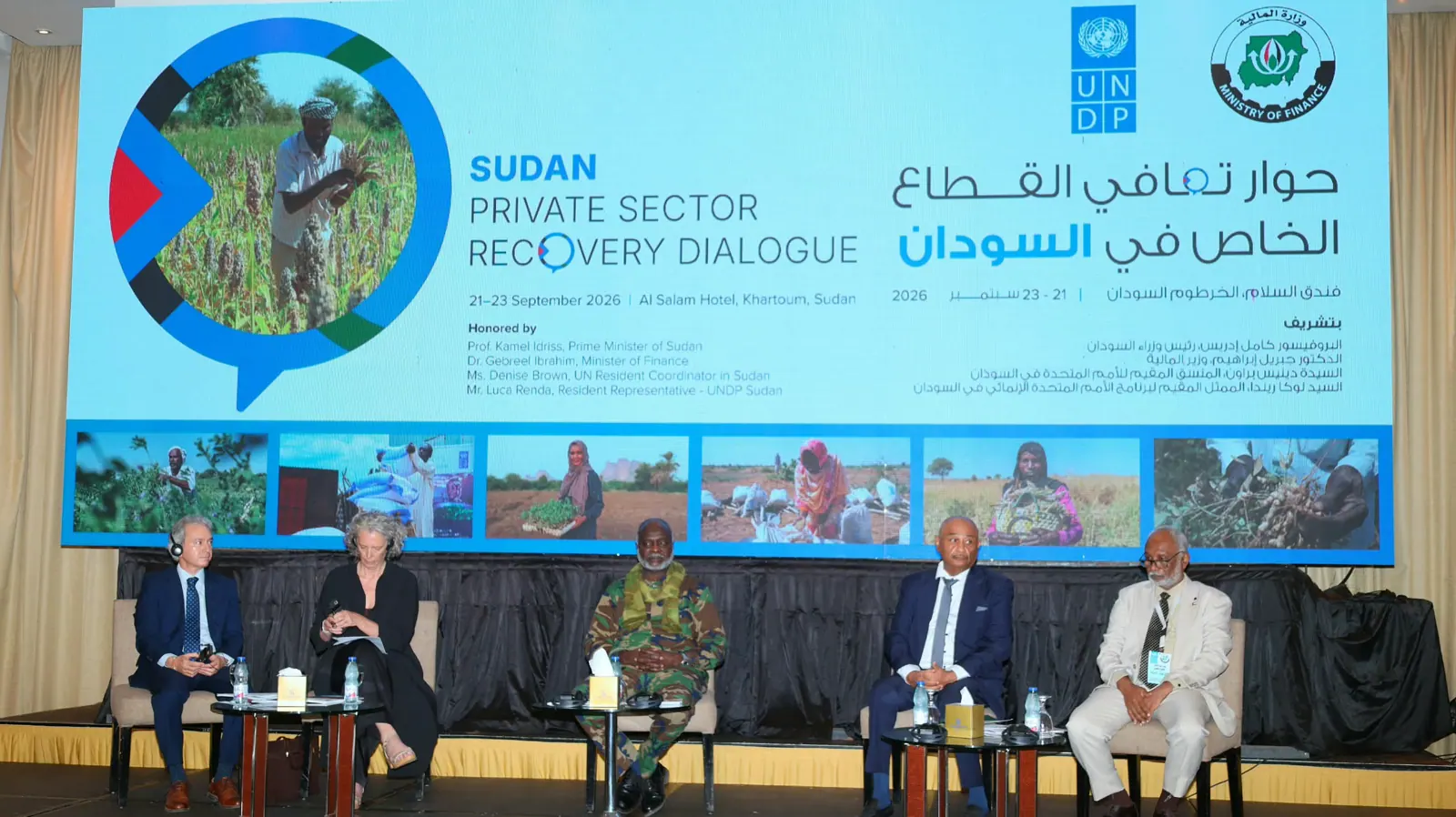
The United Nations and the World Bank have emphasized the vital role of Sudan's private sector in the country's economic recovery. At the opening of the "Private Sector Governance Dialogue" in Khartoum, the UN and World Bank, along with international partners, agreed that the private sector is the main driver of Sudan's economic recovery from the impacts of war. The event was organized by the UN Development Programme (UNDP) in partnership with Sudan's Ministry of Finance and Economic Planning.
The UNDP representative highlighted that any discussion of economic recovery without the private sector's involvement would be incomplete. He praised the resilience of Sudan's private sector, stating that despite the massive destruction, farmers continue to farm, traders transport goods, and companies operate, with citizens finding new ways to survive every day. The representative emphasized that the three-day dialogue aims to create a unified agenda for the government, private sector, financial institutions, and development partners.
The World Bank representative echoed the importance of the private sector, stating that it is not just a contributor to recovery but the primary engine for creating jobs, increasing income, and stimulating innovation and productivity. The representative commended the exceptional resilience of Sudanese farmers, traders, and business owners in providing essential goods and services despite harsh conditions.
A Pakistani business delegation expressed solidarity with Sudan, offering support and condolences for the human and material losses. The delegation highlighted the depth of economic relations between Sudan and Pakistan, with Sudan exporting sesame and cotton worth $18 million in 2022 and importing $31 million worth of medicine, tractors, and textiles. The Pakistani private sector expressed willingness to share expertise in areas such as warehouse management, Islamic finance, information technology, and solar energy solutions.
The Pakistani delegation announced plans to sign memoranda of understanding with Sudanese counterparts to facilitate trade and resolve disputes. Pakistani pharmaceutical companies also expressed readiness to meet Sudan's needs and explore local manufacturing and hospital rehabilitation. The collaboration aims to leverage Sudan's competitive advantage in meat production.
The Turkish commercial attaché emphasized Ankara's commitment to supporting Sudan's recovery efforts, citing historical ties between the two nations. Turkey continues to provide humanitarian and developmental aid through its agencies, including the Turkish Cooperation and Coordination Agency (TIKA) and the Turkish Red Crescent. The resumption of direct flights between Turkish Airlines and Port Sudan, as well as the reactivation of the Turkish Consulate and Commercial Counselor, were noted as significant steps.
The Turkish representative stressed that Sudan's recovery should be led and managed by Sudanese authorities, with a focus on empowering small and medium-sized enterprises to create jobs and transfer technology. The event highlighted the importance of partnerships and concrete commitments to drive Sudan's economic recovery.
Key points
- The UN and World Bank emphasize the private sector's crucial role in Sudan's economic recovery.
- The Sudanese private sector has shown resilience despite the impacts of war.
- International partners, including Pakistan and Turkey, offer support and expertise to aid Sudan's recovery.