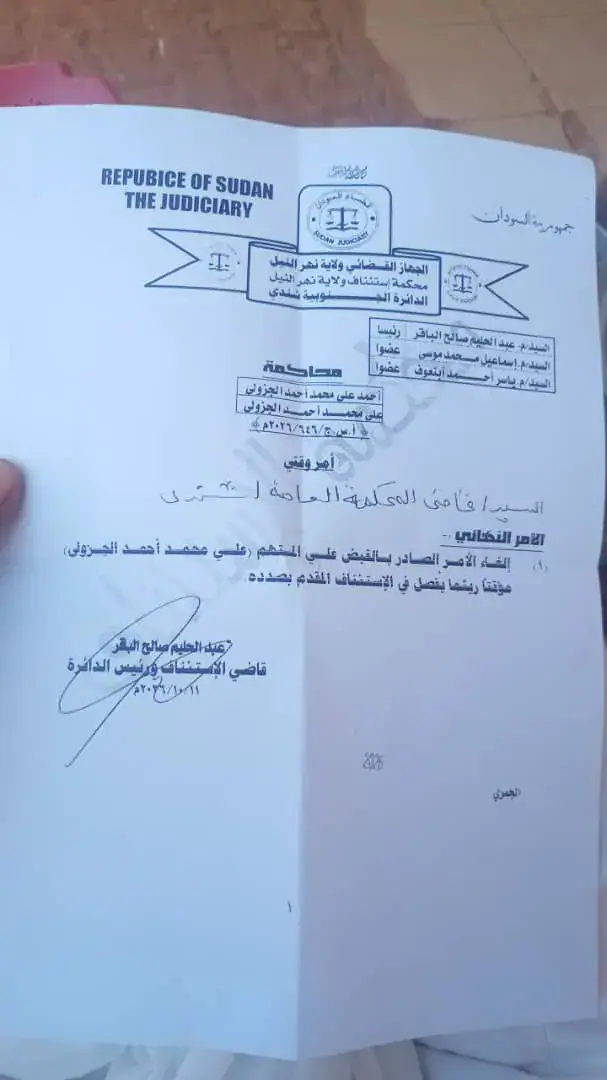
The case of Mohamed Akoud, which has been ongoing in the River Nile state's criminal courts, has seen rapid developments that have drawn attention from human rights circles and judicial affairs observers. Recently, the Shendi Court of Appeal overturned the lower court's verdict and ordered a retrial, which, according to law, means the accused will face the original charges. However, in a subsequent move, the same court issued a directive to halt the execution of an arrest warrant on the same day.
The developments have raised questions among criminal law experts about the consistency of recent procedural measures. The court's decision to overturn the verdict but not the arrest warrant has sparked concerns. This case involves serious charges, and observers believe that the contradictory decisions necessitate a review by higher judicial authorities. The case has significant implications, particularly given the high-profile nature of one of the accused.
Sources close to the matter have revealed that the head of the River Nile state's judiciary has rejected administrative requests to transfer the case files to another jurisdiction. The reasons cited for the rejection have been questioned by observers, who see this as a worrying sign of potential biases in the judicial process. Human rights groups have expressed concerns that the current judicial environment may not provide a fair trial.
The case has garnered significant attention due to the social and professional connections of one of the accused, who previously served as the state's police director. His son's role in managing the state's judicial police has also raised concerns about potential conflicts of interest. These factors have contributed to a sense of unease among the parties involved.
In response to the developments, there are reports of administrative and legal arrangements being made to transfer the case to the Khartoum state, citing the need for a fair trial. This move is seen as an effort to restore confidence in the judicial process. Human rights observers have emphasized the importance of expediting the resolution of this case to uphold the rule of law.
The case has significant implications for the social fabric of the region, and observers believe that a fair trial is essential to maintaining stability. The involvement of high-profile individuals has added to the scrutiny of the case. The judicial authorities' handling of this case will be closely watched by human rights groups and the general public.
Ultimately, the case of Mohamed Akoud highlights the challenges faced by Sudan's judicial system in ensuring fair trials, particularly in cases involving high-profile individuals. The transfer of the case to another jurisdiction may be seen as a way to address concerns about bias and ensure justice is served.
Key points
- The case of Mohamed Akoud has sparked concerns over justice and fairness in Sudan's River Nile state.
- Conflicting court decisions have raised questions about the consistency of the judicial process.
- Human rights groups are calling for a fair trial, potentially through the transfer of the case to another jurisdiction.