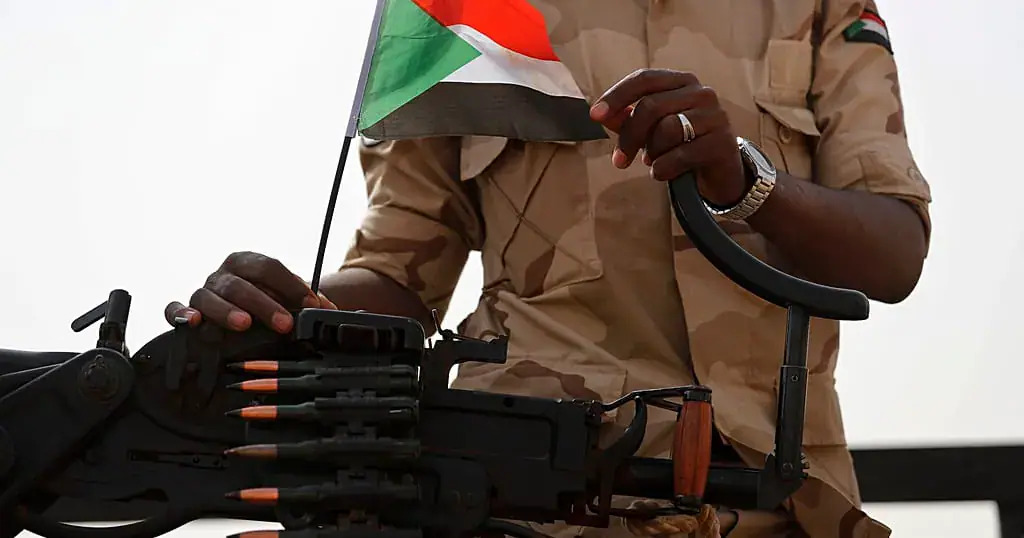
Tensions between Sudan and Ethiopia have escalated, with each accusing the other of supporting armed groups that wage war within its borders. Sudan's military claims Ethiopia has allowed Sudanese paramilitary forces to use its territory to set up camps, launch drones, and stage cross-border attacks. Ethiopia, in turn, says Sudan's military supports rebels fighting Ethiopian federal forces in its Tigray border region. The accusations undermine efforts to resolve the conflicts that have gripped the two neighboring African countries.
Sudan's military says Ethiopia backs Sudanese paramilitary forces, specifically the Rapid Support Forces (RSF), which has been battling the army since April 2023. The war has resulted in at least 59,000 deaths, according to the Armed Conflict Location & Event Data (ACLED), and displaced 13 million people. The RSF and its allies control western Darfur and parts of Kordofan, regions rich in oil fields and gold mines. Satellite imagery confirmed an increase in military vehicles and equipment at an Ethiopian military base near the Sudanese border, linked to the RSF.
Ethiopia says Sudan's military supports the Tigray People's Liberation Front (TPLF), which resumed fighting in September in Ethiopia's northern Tigray region. Ethiopia's army chief, Field Marshal Birhanu Jula, suggested that Sudan, Eritrea, and Egypt were supporting rebel troops. The allegations drew sharp denials from the three neighbors. Ethiopia expelled six staff members of Sudan's mission in Asosa and closed the consulate in early November.
The tensions between Sudan and Ethiopia risk a wider regional conflict, compounded by competing regional alliances and contentious issues over resources and disputed territory. Jervin Naidoo, a senior political economist at Oxford Economics Africa, warned that the situation raises the risk that instability inside Ethiopia becomes another front in Sudan's war — and vice versa. The conflict monitor, ACLED, reported that relations between Sudan and Ethiopia have deteriorated since the RSF established camps on Ethiopian territory.
Unresolved disputes, competing political alliances, and a flashpoint border contribute to the tensions between Sudan and Ethiopia. Ladd Serwat, senior Africa analyst at ACLED, noted that Sudan and Ethiopia don't operate in a vacuum; their relations amid these current domestic conflicts are shaped by external backers. Ethiopia is allied with the United Arab Emirates, while Sudan is part of an Egypt-Eritrea regional alliance. Turkey has been balancing, backing both Khartoum and Addis Ababa.
Other issues have marred relations between Sudan and Ethiopia, including the construction of a huge dam on the Blue Nile, the main Nile River tributary. The Grand Ethiopian Renaissance Dam, completed in 2025, aims to boost Ethiopia's power production and economy but has triggered a dispute with Egypt and Sudan over water resources. Another issue is the disputed border region of Al-Fashaga, where Ethiopian farmers have long cultivated the area's fertile soil.
The Sudan-Ethiopia tensions may lead to mass displacements of people if ignored. The situation requires attention to prevent further escalation and destabilization of the region. The International Crisis Group's Horn of Africa project director, Alan Boswell, warned that continued fighting in Tigray could divert Ethiopia's attention from its myriad other issues and increase the risk of weapons and fighters flowing across the border with Sudan.
Key points
- Sudan and Ethiopia accuse each other of supporting armed groups within their borders.
- The tensions risk a wider regional conflict, compounded by competing regional alliances and contentious issues over resources and disputed territory.
- The conflict has resulted in significant human suffering, with at least 59,000 deaths and 13 million displaced people.