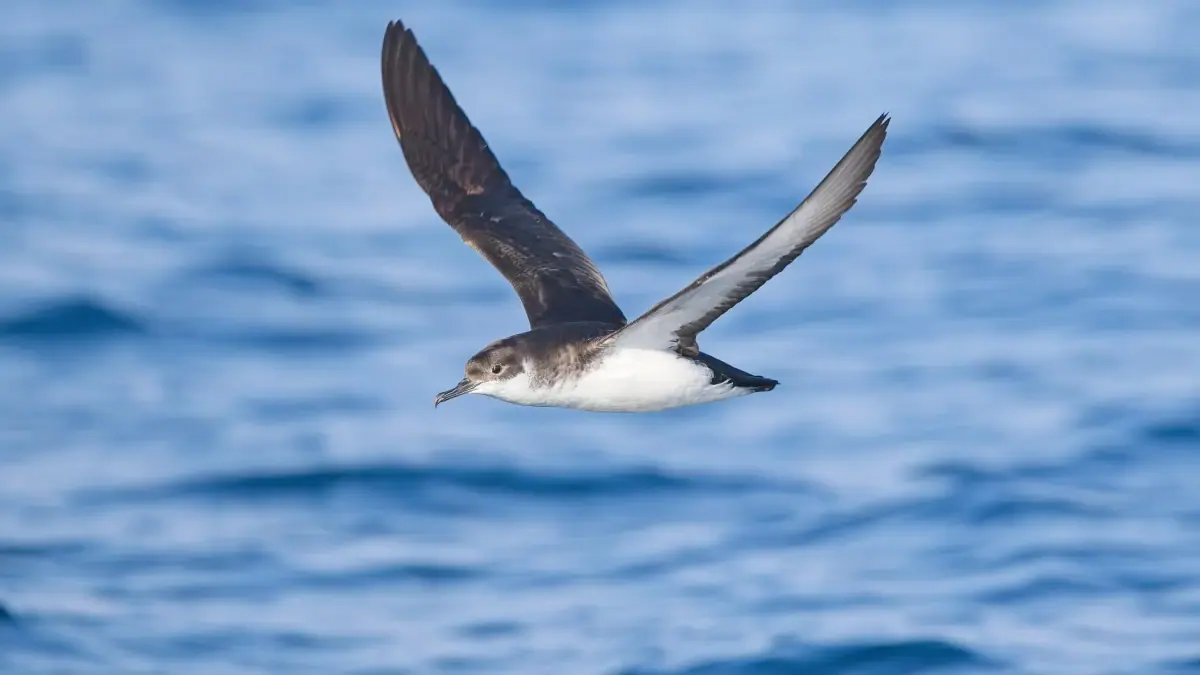
A recent study published in the journal Science has found that Manx shearwaters, a type of seabird, experience a form of jet lag during their long flights across the Atlantic Ocean. The research, conducted by behavioral ecologist Patrick Lewin at the University of Oxford, reveals that these birds become slightly disoriented due to their internal clock falling out of sync with the sun's position in the sky. This phenomenon was observed in the birds' flight patterns, which showed a seven-degree error, resulting in a three-mile deviation from their intended course.
Manx shearwaters are common in the British Isles and are closely related to albatrosses. They are known to mate for life, with couples laying a single egg and taking turns incubating it. One partner will sit on the egg for extended periods while the other hunts for food in the North Atlantic, often traveling hundreds of miles from their nests. Once their bellies are full, they quickly return to their colonies, often completing the long journey in just a day or so. This unique behavior raised questions about whether these birds experience jet lag, similar to humans.
To investigate this phenomenon, Lewin utilized GPS tracking data collected over 20 years from Manx shearwaters. By analyzing their flight patterns, he discovered that the birds use the sun as a compass to navigate. However, if their internal clock is out of sync, they would fly in the wrong direction. The study found that as the birds rushed back to their partners and eggs, they veered slightly off course, resulting in a small but significant deviation from their intended route.
The study's findings have significant implications for our understanding of animal navigation. According to Alice Boyle, a biologist at Western University in Ontario, Canada, the research provides valuable insights into the navigation decisions of wild animals. Boyle noted that almost every creature on the planet must navigate its environment, but it is rare to see studies demonstrating navigation decisions in action. The use of GPS tracking technology has enabled researchers to learn more about the behavior of wild birds that travel to remote areas.
The study's results also highlight the remarkable adaptability of Manx shearwaters. Despite experiencing a form of jet lag, the birds are able to adjust their flight patterns and still complete their long journeys. Lewin noted that the error in their flight paths was relatively small, with a maximum deviation of seven degrees, resulting in only a three-mile detour from their intended course.
The research has broader implications for our understanding of animal behavior and navigation. By studying the behavior of Manx shearwaters and other wild animals, researchers can gain insights into the complex interactions between animals and their environments. This knowledge can be used to inform conservation efforts and improve our understanding of the natural world.
The study's findings are a significant contribution to the field of animal behavior and navigation. The use of GPS tracking technology has enabled researchers to collect valuable data on the behavior of wild animals, providing new insights into their navigation decisions. As researchers continue to study the behavior of Manx shearwaters and other animals, we can expect to learn more about the complex interactions between animals and their environments.
Key points
- Manx shearwaters experience a form of jet lag during long flights across the Atlantic Ocean due to their internal clock desyncing with the sun's position in the sky.