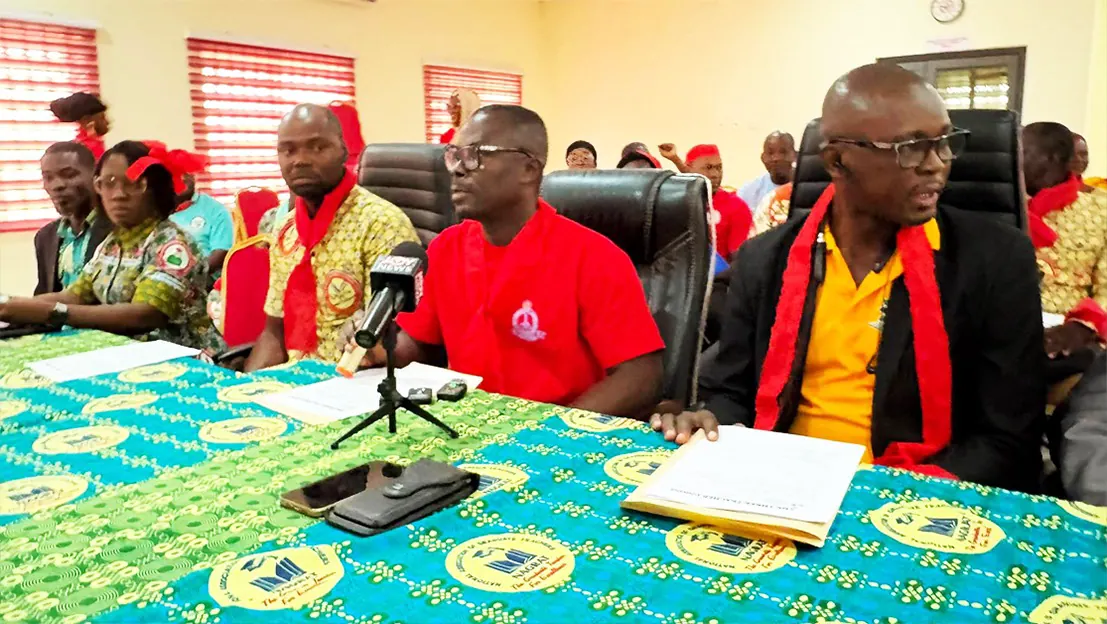
The leadership of pre-tertiary teacher unions in Ghana's Upper West Region has announced that its members will not call off their ongoing nationwide strike until the government produces verifiable proof that their longstanding grievances have been addressed. The unions, which include the Ghana National Association of Teachers (GNAT), the National Association of Graduate Teachers (NAGRAT), and the Coalition of Concerned Teachers Ghana (CCT-GH), reaffirmed their solidarity with their national leadership at a joint press conference in Wa.
The industrial action is centered on three main issues: stalled negotiations on their expired Collective Agreement, failure to place promoted teachers on their corresponding salary scales with accumulated arrears paid, and the non-implementation of the agreed 20% deprived area allowance. According to Ransford Owusu-Adjei, Upper West Regional Secretary of GNAT, verbal assurances and unfulfilled timelines from the government and their employer are no longer sufficient.
The unions emphasized that they have waited long enough for the government to address their concerns, having engaged in negotiations, exercised patience, and listened to assurances and promises. However, they stressed that assurances alone can no longer resolve these matters. Owusu-Adjei stated that a promotion without corresponding financial implementation is incomplete, and that teachers have earned their promotions and assumed the responsibilities attached to them.
The unions are demanding evidence that the government has implemented the agreed-upon measures, particularly with regards to promotions and the 20% deprived area allowance. Owusu-Adjei insisted that the era of promises without implementation must end, and that if the employer claims teachers have been paid, they should show evidence. He added that teachers serving in deprived communities have worked under difficult conditions for a decade while waiting for the agreed-upon allowance to be rolled out.
Dominic Yaw Tunti, Upper West Regional Chairman of NAGRAT, described the situation as dire, cautioning parents to keep their children home for their own safety. He stated that the effect of the strike is glaring, with schools deserted and only pupils and students present without teachers. Tunti agreed with parents that they should not allow their children to go to school, as they do not know what may happen to them when there are no teachers to supervise them.
The strike has significant implications for the education sector in Ghana, with parents and students bearing the brunt of the industrial action. The unions' demands are centered on improving working conditions and ensuring that teachers are fairly compensated for their work. The government is yet to respond to the unions' demands, and it remains to be seen how the situation will be resolved.
The pre-tertiary teacher unions in Ghana's Upper West Region are resolute in their determination to see their demands met, and it appears that the strike will continue until the government provides concrete evidence of addressing their grievances. The situation is being closely watched by stakeholders in the education sector, who are eager to see a resolution to the impasse.
Key points
- The pre-tertiary teacher unions in Ghana's Upper West Region will not end their nationwide strike until the government provides verifiable proof that their longstanding grievances have been addressed.
- The industrial action is centered on three main issues: stalled negotiations on their expired Collective Agreement, failure to place promoted teachers on their corresponding salary scales with accumulated arrears paid, and the non-implementation of the agreed 20% deprived area allowance.
- The unions are demanding evidence that the government has implemented the agreed-upon measures, particularly with regards to promotions and the 20% deprived area allowance.