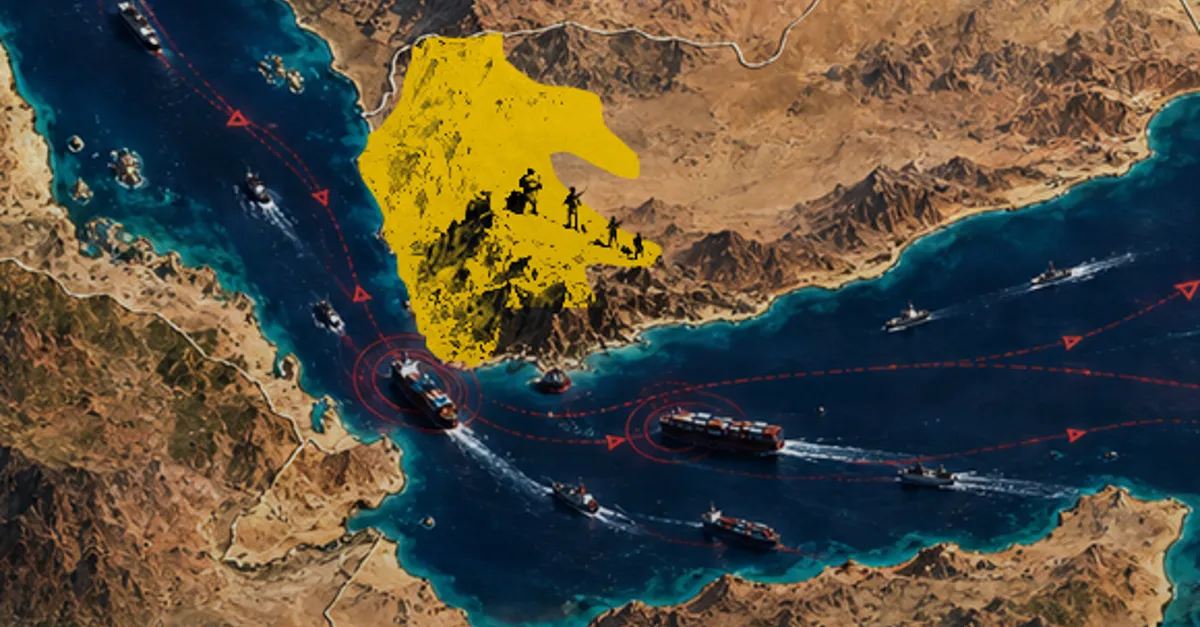
The Houthi group's surprise takeover of the Hanish archipelago, including Greater and Lesser Hanish and Zaqar islands, along with the city and port of Mocha and Mayun Island, has significantly altered the military and geopolitical landscape in the southern Red Sea. This development has redrawn the map of influence around the Bab al-Mandab Strait and heightened risks to international navigation and trade. The islands' strategic location allows the controlling party to monitor and impact international shipping routes.
The islands of Mayun, Greater Hanish, and Lesser Hanish are crucial points in Yemen's maritime strategy in the southern Red Sea. Their geographical location enables the controlling party to monitor international shipping lines and influence vessel traffic through the Bab al-Mandab Strait. Mayun Island, situated in the heart of the strait, is particularly sensitive, dividing the strait into two channels: the Eastern Channel, or "Little Mandab," and the Western Channel, or "Daqa Mayun."
The Hanish archipelago, located north of the Bab al-Mandab Strait, opposite the Yemeni coast and facing the Eritrean coast, holds significant strategic importance. The islands serve as a line of defense and early warning system for the strait, allowing for monitoring of northern approaches and maritime lines leading to Yemeni coastal ports. The archipelago's geography also enables its use as a logistical and operational depth for supporting and supplying military operations.
The integration of the Hanish and Mayun islands forms a strategic domain around the southern entrance to the Red Sea, giving the controlling party greater influence over the security environment surrounding the Bab al-Mandab Strait. Throughout history, these islands have played various roles in shaping regional military and security equations. The British occupied Mayun Island in 1857, establishing a lighthouse and facilities to support navigation and shipping.
The strategic importance of the Bab al-Mandab Strait was highlighted during the 1973 October War, when Egypt and South Yemen coordinated to impose a blockade on Israeli navigation to and from the port of Eilat. Egyptian naval units were deployed to monitor shipping in the area, emphasizing the strait's value in regional conflict. The Yemeni civil war and regional rivalries have continued to impact the islands, with various parties vying for control.
Recent developments have seen the Houthi group take control of the Mocha, Mayun, Zaqar, Greater Hanish, and Lesser Hanish islands, altering the balance of power in the southern Red Sea. This shift has raised concerns among regional and international actors, given the connection to Bab al-Mandab's security and Red Sea navigation. The Yemeni government, Saudi Arabia, and Egypt are closely watching the developments, with implications for regional security and trade.
The international community is monitoring the situation, with concerns about the impact on global trade and navigation. The Houthi group's control of strategic islands and ports in the Red Sea has significant implications for regional dynamics and global maritime security. The developments have sparked a re-evaluation of military and diplomatic strategies in the region.
Key points
- The Houthi group's control of strategic islands in the Red Sea has significant implications for regional dynamics and global maritime security.
- The islands' strategic location allows the controlling party to monitor and impact international shipping routes.
- The developments have raised concerns among regional and international actors, given the connection to Bab al-Mandab's security and Red Sea navigation.