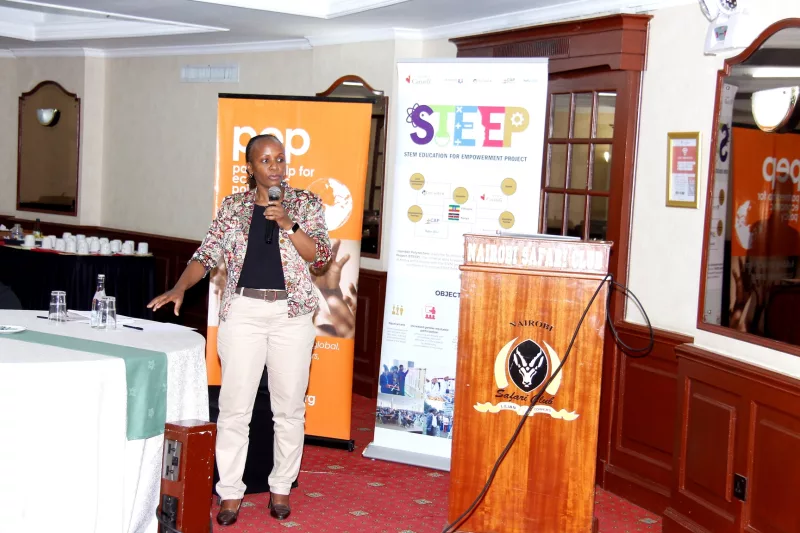
A recent study presented in Nairobi found that young women who took part in a targeted STEM TVET training programme had better employment outcomes and higher earnings compared to their peers who did not participate. The study, co-authored by Dr Phyllis Machio and Dr Bernadette Wanjala, found that 63 per cent of women who participated in the STEM Education for Empowerment Project (STEEP) were employed, compared to 48 per cent of applicants who were not selected and 52 per cent of comparable young women who did not apply.
The study, which was funded by the Government of Canada and the Barrett Family Foundation, used econometric analysis to estimate that participation in the STEEP programme increased the likelihood of employment by up to 26 per cent compared to one comparison group and 18 per cent compared to the other. Additionally, monthly earnings were estimated to be 22 per cent higher for participants. The findings suggest that STEM training can have a positive impact on employment outcomes and earnings for young women in Kenya.
The STEEP programme, which was implemented by the CAP Youth Empowerment Institute (CAP YEI), aimed to support out-of-school adolescent girls from vulnerable backgrounds with technical and soft skills to prepare them for STEM training and employment. The programme combined technical training, life skills, mentorship, and work-based learning, and was conducted across six locations in Kenya. The training included market-relevant technical pathways in areas such as food and beverage production, electrical installation, and plumbing.
The study also found that training alone is not enough to remove the barriers women face when moving into employment. Participants identified several challenges, including the short duration of training, lack of formal certification, and the cost of NITA examination fees. Some participants who had completed training were unable to secure opportunities with formal companies because they did not have the required certification. Discrimination and harassment in male-dominated workplaces were also reported.
The researchers recommend expanding the STEEP model to marginalised counties, embedding structured life-skills training and female mentorship into TVET STEM programmes, and developing stronger public-private partnerships to provide internships linked to employment. They also suggest strengthening workplace safeguards for women entering STEM careers. According to CAP YEI representative Dennis Muchiri, skilling alone is not the end goal, and the programme approach should focus on getting people skills, adjusting their attitude, and giving them knowledge.
The findings are significant given the continued gender disparity in technical education in Kenya. Women account for only 38 per cent of STEM enrolment in Kenya's TVET institutions. The study's results highlight the importance of practical workplace experience in building confidence and securing employment. Internships emerged as a crucial bridge between training and employment, with some participants moving directly into employment after completing their internships.
The study was led by Humber Polytechnic's International Development Institute, with CAP YEI as the implementing partner in Kenya. The research was supported by the Partnership for Economic Policy through its Learning and Knowledge Management Project, with funding from Global Affairs Canada. The policy briefing provided an opportunity for stakeholders to consider how evidence from STEEP can inform future approaches to women's participation in STEM, TVET, and employment in Kenya.
Key points
- Participation in the STEEP programme increased the likelihood of employment by up to 26 per cent compared to one comparison group and 18 per cent compared to the other.
- Monthly earnings were estimated to be 22 per cent higher for participants in the STEEP programme.
- Women account for only 38 per cent of STEM enrolment in Kenya's TVET institutions.