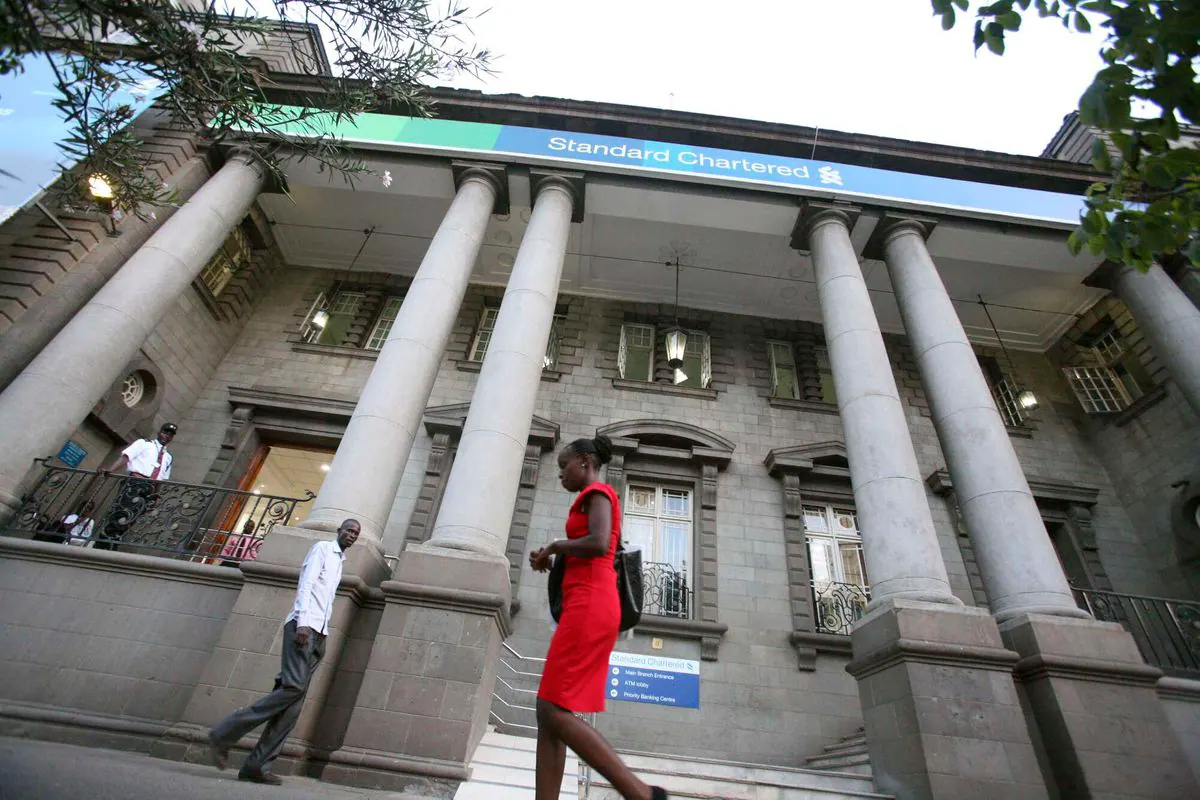
Multinational banks operating in Kenya have lost market share to homegrown lenders over the past seven years. According to data from the Central Bank of Kenya, local institutions such as KCB Bank Kenya and Equity Bank Kenya have progressively claimed a larger share of the market. This shift is measured through net assets, customer deposits, loan book, deposit and loan accounts, and shareholder equity. As a result, Standard Chartered Bank Kenya has dropped off the list of tier one lenders.
StanChart's market share fell from 6.37 percent in 2019 to 4.5 percent in 2025, resulting in its drop into the second tier of banks. In 2019, the lender was ranked sixth in size in the market but has since been overtaken by DTB, I&M Bank, and Stanbic Bank. Absa's market share also dropped from 6.8 percent to 6.4 percent over the seven years, although the bank maintained its position as the country's fifth-largest lender by market size.
The Central Bank of Kenya segregates banking tiers based on a market size index. The top tier comprises lenders with a share of five percent or more. Tier two or medium-sized banks have a market share of between one and five percent, while those with a share below one percent are classified as tier three or small banks. The market is dominated by large banks in terms of assets and profits.
KCB led the banking sector with a market share of 17.3 percent as of December 2025, followed by Equity and Co-operative Bank of Kenya at 11.8 percent and 9.4 percent, respectively. KCB's share has expanded from 13.89 percent in 2019, and Equity's from 10.24 percent. Their respective balance sheets have risen above the Sh1 trillion mark. KCB grew its net assets from Sh674.3 billion in 2019 to Sh1.49 trillion in 2025.
In contrast, StanChart's net assets grew by only a fifth to Sh364.5 billion from Sh302.3 billion. Absa's net assets rose from Sh374.1 billion to Sh536.7 billion, a growth of 43.5 percent. The faster expansion of local lenders has partly drawn from their investment in digital and physical outlets to gather larger volumes of deposits and hand out more loans.
Multinational lenders have also been more willing to distribute a larger share of their profits as dividends to their shareholders. In the financial year ended December 2025, StanChart distributed Sh11.71 billion in dividends at a rate of Sh31 per share, equivalent to 94 percent of its net profit. Absa paid out 49 percent of its net profit to shareholders as dividends, equivalent to Sh11.14 billion.
The retained profits for local lenders give them a sizable capital war chest with which to lend more to customers and government, and also to fund regional expansion. KCB, at group level, distributed 34 percent of its net profit, translating to a payout of Sh22.49 billion against net earnings of Sh66.82 billion. Equity Group had a payout ratio of 30 percent after distributing Sh21.7 billion from its net profit of Sh71.96 billion in 2025.
Key points
- Local lenders like KCB and Equity Bank have gained market share at the expense of multinational banks like StanChart and Absa.
- StanChart's market share fell from 6.37 percent in 2019 to 4.5 percent in 2025.
- KCB led the banking sector with a market share of 17.3 percent as of December 2025.