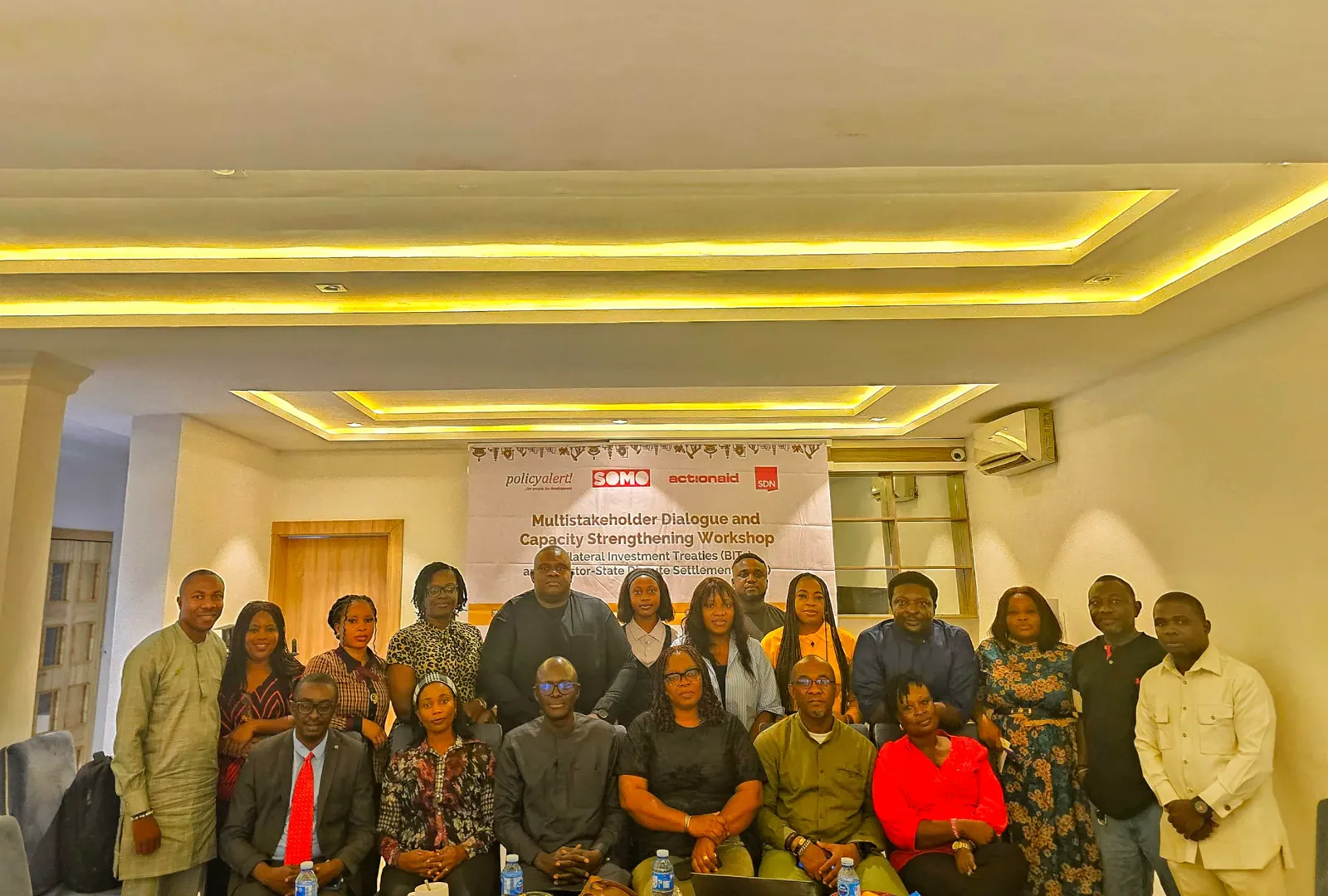
Civil society organisations, host-community representatives, researchers, and other stakeholders have urged the Nigerian government to review its bilateral investment treaties, warning that investor-protection provisions could hinder the country's ability to enforce environmental regulations and pursue energy transition policies. This call was made at a multi-stakeholder roundtable on Investor-State Dispute Settlement, energy transition, and investment governance held in Port Harcourt, Rivers State, on 16 September. The event was convened by Policy Alert in partnership with the Social Development Integrated Network and ActionAid, with support from the Centre for Research on Multinational Corporations.
The stakeholders expressed concern that the Investor-State Dispute Settlement provisions in Nigeria's bilateral investment treaties, such as the 1992 Nigeria-Netherlands Bilateral Investment Treaty, could create a "chilling effect" on the government's willingness to introduce or enforce environmental and climate regulations. This is due to the possibility of arbitration claims by investors, which could constrain the country's ability to regulate in the public interest. The issue has become more significant as Nigeria attempts to balance continued investment in oil and gas with its stated commitment to an energy transition.
The participants identified Shell's offshore investments in the Bonga field, the federal government's Decade of Gas initiative, and the continuing divestment of oil assets in the Niger Delta as developments that could expose the country to additional investment-related disputes. They noted that the Bonga investment, in particular, illustrated the need for Nigeria to examine the potential legal consequences of its treaty commitments. Shell and its partners recently announced a final investment decision on the $5 billion Bonga North deepwater project, expected to increase Nigeria's oil production capacity by about 110,000 barrels per day.
The stakeholders also questioned the legal and fiscal implications of Nigeria's Decade of Gas initiative, arguing that the expansion of gas infrastructure could increase the volume of foreign investment potentially protected by investment treaties. This could create additional exposure to arbitration claims while potentially committing the country to fossil-fuel infrastructure for decades. The federal government has presented gas as a key component of Nigeria's energy transition and energy security strategy, including the launch of the National Grassroots LPG Penetration Programme.
The participants linked Investor-State Dispute Settlement concerns to the wave of oil asset divestments by international oil companies in the Niger Delta. They argued that multinational companies exiting onshore operations while retaining offshore interests could create difficult questions over responsibility for historical pollution and environmental remediation. This follows growing scrutiny of oil-company divestments in Nigeria, including a review of 26 oil blocks valued at $6.03 billion involved in divestment transactions by five international oil companies.
The stakeholders called on the Nigerian government to review and, where necessary, renegotiate existing bilateral investment treaties to ensure that treaty obligations do not undermine the government's authority to regulate in the public interest. They also recommended that the Federal Government conduct a comprehensive assessment of the potential Investor-State Dispute Settlement exposure associated with the Decade of Gas initiative. Additionally, they urged the Nigerian Upstream Petroleum Regulatory Commission to establish binding requirements ensuring that companies settle or adequately secure legacy environmental liabilities before completing divestments.
The 1992 Nigeria-Netherlands Bilateral Investment Treaty featured prominently in the discussions, with the stakeholders noting that Nigeria should examine its treaty commitments to avoid potential disputes. The issue of Nigeria's exposure to international investment arbitration is not theoretical, as evidenced by the long-running OPL 245 dispute, which involved Italian energy companies initiating arbitration proceedings against Nigeria at the International Centre for Settlement of Investment Disputes. The Attorney-General of the Federation, Lateef Fagbemi, said in March that Nigeria had faced potential liability exceeding $2 billion in damages and associated costs in connection with the dispute.
Key points
- The Nigerian government is urged to review its bilateral investment treaties to avoid potential disputes and ensure that treaty obligations do not undermine its authority to regulate in the public interest.
- The expansion of gas infrastructure under Nigeria's Decade of Gas initiative could increase the volume of foreign investment potentially protected by investment treaties, creating additional exposure to arbitration claims.
- The stakeholders recommend that the Federal Government conduct a comprehensive assessment of the potential Investor-State Dispute Settlement exposure associated with the Decade of Gas initiative.