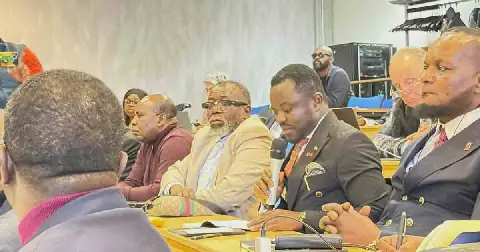
The Democratic Republic of Congo recently played host to a two-day workshop that brought together various stakeholders to discuss responsible and transparent forestry governance. Held on November 3 and 4, the workshop was organized by Environews with support from the Pulitzer Center. The event aimed to evaluate the role of information and investigative journalism in informing public policy and opinion. Stakeholders sought to promote a critical and constructive public debate on the future of DR Congo's forests.
The workshop focused on developing a draft collaborative guide for accessing information, which will serve as a reference document for defining concrete and permanent mechanisms for exchanging information among stakeholders. According to the organizers, this guide is crucial for promoting equitable, responsible, and sustainable forestry governance in the face of environmental and socio-economic pressures on the Congo Basin. The stakeholders present included public institutions, civil society, the private sector, and media professionals.
The Director General of Environews, Alfred Ntumba, emphasized the importance of transparency, accountability, and sincere dialogue among all stakeholders in forestry governance. He noted that investigative journalism and civil society alerts are often isolated, while the efforts and constraints of public institutions remain unknown to the general public. The workshop provided a platform for journalists, government representatives, civil society leaders, researchers, and private sector actors to examine journalistic investigations and reports from a different perspective.
Afy Malungu, Programme Manager at the Pulitzer Center, stressed that responsible forestry governance cannot be achieved in isolation. She emphasized the need for actors to engage in dialogue, share knowledge, and address the concerns of local populations. According to Malungu, information is most valuable when it facilitates discussion and raises questions. The Pulitzer Center is supporting the workshop to create a space where facts, field experiences, and diverse perspectives can converge.
Teddy Tendayi, Director of Archives and New Information and Communication Technologies at the Ministry of Environment, highlighted the significance of the workshop in promoting transparency in forestry governance. He noted that the exchange will foster dialogue, experience sharing, and the development of a common vision among journalists, public institutions, and civil society. The stakeholders are working together to build a collaborative guide that will promote responsible forestry governance.
The workshop is a significant step towards promoting transparency and accountability in DR Congo's forestry sector. The stakeholders present acknowledged the need for a collaborative approach to address the complex environmental and socio-economic challenges facing the Congo Basin. By working together, the stakeholders aim to develop a comprehensive guide that will inform and support responsible forestry governance.
The development of the collaborative guide is expected to have a positive impact on forestry governance in DR Congo. The guide will provide a framework for stakeholders to engage in constructive dialogue and share information, promoting transparency and accountability in the sector. The workshop's outcomes are expected to contribute to the development of more effective policies and practices that prioritize sustainable and responsible forestry governance.
Key points
- DR Congo hosts multi-stakeholder workshop to develop guide for transparent and responsible forestry governance
- Workshop aims to promote transparency, accountability, and dialogue among stakeholders in forestry governance
- Collaborative guide to be developed to support responsible forestry governance in DR Congo