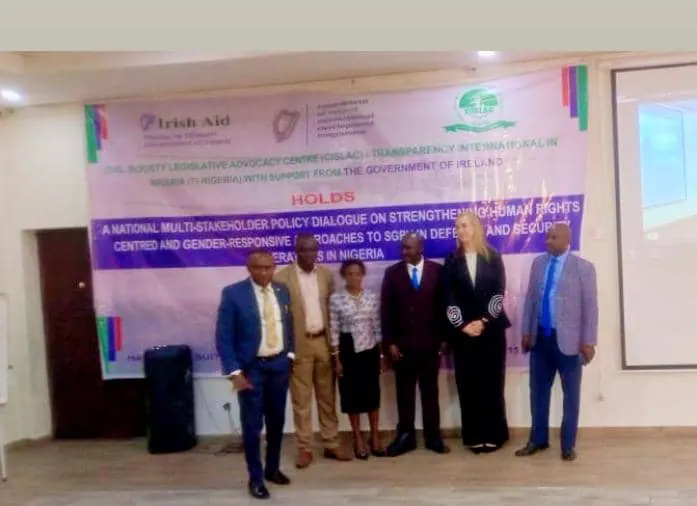
Stakeholders from security institutions, government agencies, civil society, diplomatic missions, and development partners gathered in Abuja for a National Multi-Stakeholder Policy Dialogue. The event, organised by the Civil Society Legislative Advocacy Centre (CISLAC) and Transparency International Chapter in Nigeria (TI-Nigeria), with support from the Government of Ireland, aimed to strengthen human rights-centred and gender-responsive approaches to SGBV in defence and security operations. The dialogue addressed the need for effective mechanisms to prevent and respond to SGBV.
Comrade Auwal Ibrahim Musa (Rafsanjani), Executive Director of CISLAC/TI-Nigeria, emphasised that the effectiveness of defence and security institutions should not be measured solely by their operational capacity. SGBV remains a serious concern that can affect security personnel, civilians, and communities affected by conflict and insecurity. Rafsanjani stressed the importance of safe, accessible, confidential, and reliable reporting mechanisms to ensure that allegations of SGBV are properly addressed.
Rafsanjani expressed concerns over confidentiality and power imbalances, which may discourage victims and complainants from reporting incidents. He noted that addressing these challenges requires more than policies on paper; security institutions must establish systems that personnel and members of the public can trust and safely use. Rafsanjani called for stronger integration of gender considerations into recruitment, deployment, leadership, training, operational planning, and institutional decision-making.
Representing the Inspector-General of Police, IGP Olatunji Rilwan Disu, the Head of the Complaint Response Unit (CRU), SP Awu Fidelis Jonah, assured of the Nigeria Police Force's (NPF) commitment to preventing SGBV and strengthening accountability. Jonah emphasised that preventing and responding effectively to SGBV requires security institutions to operate with professionalism, integrity, accountability, and respect for human dignity.
The Humanitarian Development Officer of the Embassy of Ireland in Nigeria, Samuel Ameh, said the Government of Ireland was proud to support CISLAC/TI-Nigeria in advancing efforts to address gender-based sexual violence and promote good governance. Ameh noted that embedding human rights principles in security operations strengthens protection for survivors, improves access to justice, and promotes accountability.
The First Secretary of the Embassy of the Netherlands, Dineke Traore-Vrolyk, emphasised that security, human rights, integrity, and accountability must go hand in hand. Traore-Vrolyk said effective security institutions must protect the people they serve, operate professionally and transparently, and earn public trust. The Netherlands' partnership with CISLAC focuses on integrity risks and gender inclusion.
The stakeholders identified five priority areas for the dialogue: prevention, safe reporting, institutional accountability, gender-responsive security operations, and coordination and oversight. The dialogue aimed to assess how effectively existing commitments and mechanisms operate in practice, whether reporting channels are accessible, and whether survivors are adequately protected. The event promoted greater participation of women in recruitment, appointment, promotion, and deployment.
Key points
- Stakeholders call for gender-responsive approaches to SGBV in Nigeria's security sector.
- The dialogue aimed to strengthen human rights-centred and gender-responsive approaches to SGBV in defence and security operations.
- Security institutions must establish systems that personnel and members of the public can trust and safely use to report SGBV incidents.