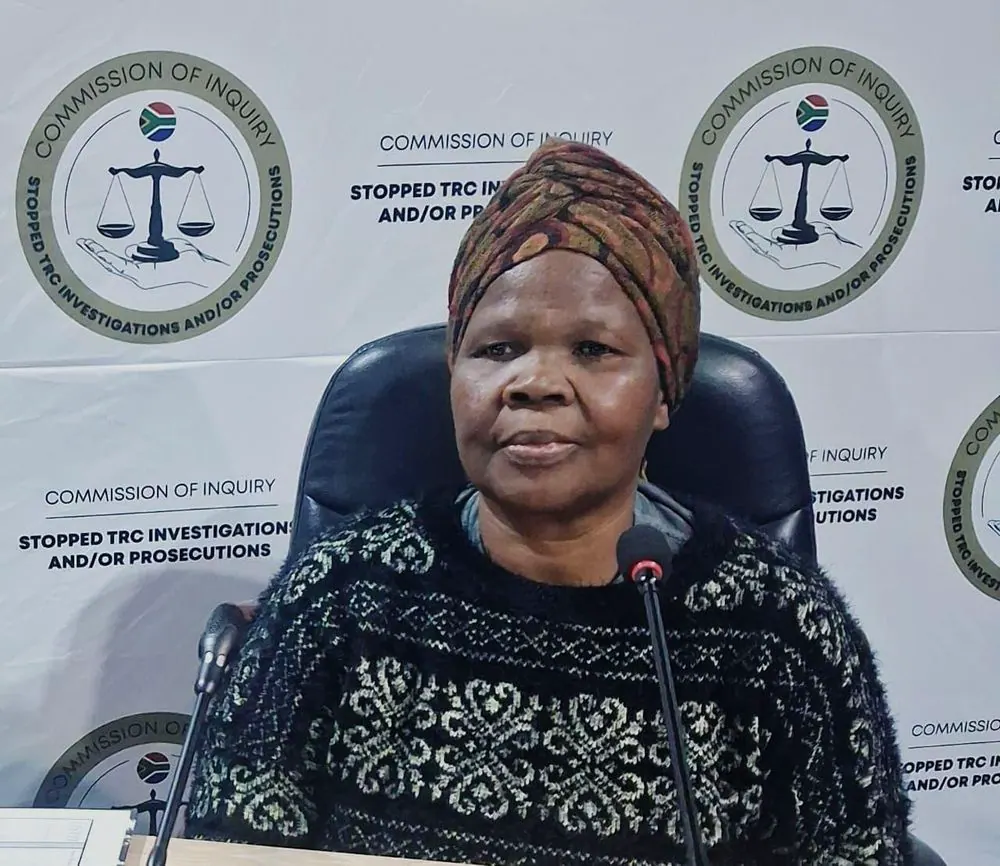
Nomarussia Bonase, a member of the Khulumani Galela group, testified at the TRC Cases Inquiry on Tuesday about the traumatic experience of watching her 23-year-old brother being killed by apartheid security forces, known as "stability soldiers," while awaiting public transport in Germiston in 1993. Bonase recounted the anguish of losing her brother and the violations her family suffered during their upbringing in Thokoza, Ekurhuleni. Her testimony was presented to the chairperson of the commission, Justice Sisi Khampepe.
Bonase expressed her frustration at being denied the opportunity to present her case to the Truth and Reconciliation Commission (TRC) since its inception in 1997. She had attempted to reach out to former President Thabo Mbeki and Minister of Justice Penuel Maduna, but her efforts were ignored. Bonase lamented that the government was quick to give amnesty to perpetrators of apartheid-era crimes but failed to provide support to victims and survivors.
The TRC, established in 1997, was tasked with investigating human rights violations during apartheid. However, Bonase stated that it was only now, through the Khampepe Commission, that she discovered the TRC had formally examined train violence in the East Rand and made findings over 25 years ago. This revelation highlights the lack of communication and support provided to victims and survivors during and after the TRC's operations.
Bonase also expressed her gratitude for the current commission's efforts to acknowledge the pain and suffering endured by victims. She emphasized that since the closure of the TRC in 2003, it has been clear that the government did not want to provide reparations or compensation to victims and survivors. Bonase's testimony underscores the ongoing struggle for justice and recognition faced by many who suffered during apartheid.
The Khampepe Commission's proceedings were adjourned for two days following Bonase's testimony, with the next session scheduled for Friday, October 9, at 10 am. The commission's efforts to uncover the truth and provide a platform for victims to share their experiences are ongoing. Former Presidents Mbeki and Jacob Zuma are set to appear before the inquiry on October 19 and 22, respectively.
The Constitutional Court recently dismissed an application from both former presidents seeking the recusal of Justice Khampepe. This development allows the commission to continue its work without delay. The appearance of high-profile witnesses, including former presidents, is expected to shed more light on the government's role in apartheid-era violence and the subsequent handling of TRC recommendations.
The Khampepe Commission's work serves as a crucial step towards addressing the historical injustices faced by victims and survivors of apartheid. As the commission continues to hear testimonies and gather evidence, it is clear that the road to truth and reconciliation in South Africa is ongoing. The commission's efforts aim to provide closure and recognition to those who suffered during apartheid, and its findings may have significant implications for the country's ongoing pursuit of justice and healing.
Key points
- Nomarussia Bonase testified about her brother's killing by apartheid security forces.
- The government was criticized for ignoring victims and survivors while granting amnesty to perpetrators.
- The Khampepe Commission continues its work, with former presidents set to appear as witnesses.