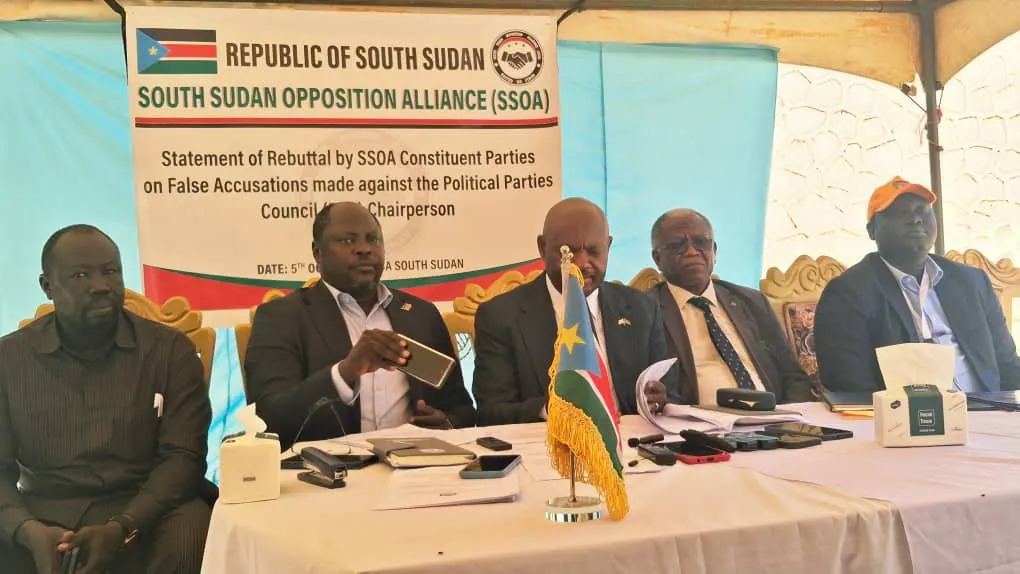
A faction of the South Sudan Opposition Alliance (SSOA) has defended the registration of seven constituent parties with the Political Parties Council (PPC). According to SSOA faction Secretary-General Changkuoth Bichiock, the parties had relinquished military command and met legal requirements to operate as civilian organisations. The seven parties include the South Sudan Patriotic Movement, South Sudan National Movement for Change, Federal Democratic Party, and National Salvation Front, among others.
The SSOA is divided into two main factions, with several splinter groups aligned with either side. One faction, led by former Vice President Hussein Abdelbagi Akol, is seen as close to the ruling Sudan People’s Liberation Movement, while the other is led by former Vice President Josephine Lagu. The dispute follows accusations by the National Democratic Movement and the South Sudan National Movement for Change that the PPC had fraudulently altered their registration records.
Bichiock stated that the registration process was delayed due to the parties' previous association with military wings. Their leaders had to relinquish military command before the groups could operate solely as civilian political organisations. The leaders of the seven parties relinquished military command in December 2025 and surrendered their forces to the commander-in-chief of the regular forces.
The PPC registration process was guided by Section 26 of the Political Parties Act of 2012, as amended in 2022. The Act prohibits political parties from establishing covert or military formations, armed forces, or paramilitary forces. Bichiock accused groups associated with Lam Akol and Moro of failing to meet the same requirement, alleging they maintained independent military structures while seeking registration as political parties.
Clement Juma Mbugoniwa of the South Sudan National Movement for Change said the seven parties followed the required legal procedures for registration under South Sudan’s laws and the 2018 peace agreement. He emphasised the groups' commitment to civil politics, citing demands from the South Sudanese people.
Gassim Barnaba of the National Salvation Front stated that his group had transitioned from a military movement into a political organisation. He noted that retaining military wings could intimidate civilians and that political parties should not have military wings.
The dispute arises as South Sudan prepares for elections scheduled for December 22, after years of delays under the country’s transitional political arrangements. The SSOA faction's defence of the PPC registration comes amid accusations of fraudulent alterations to registration records and allegations of non-compliance with legal requirements.
Key points
- The SSOA faction defends PPC registration of seven parties, citing compliance with laws.
- The dispute highlights divisions within the SSOA and allegations of non-compliance with legal requirements.
- The situation arises as South Sudan prepares for upcoming elections.