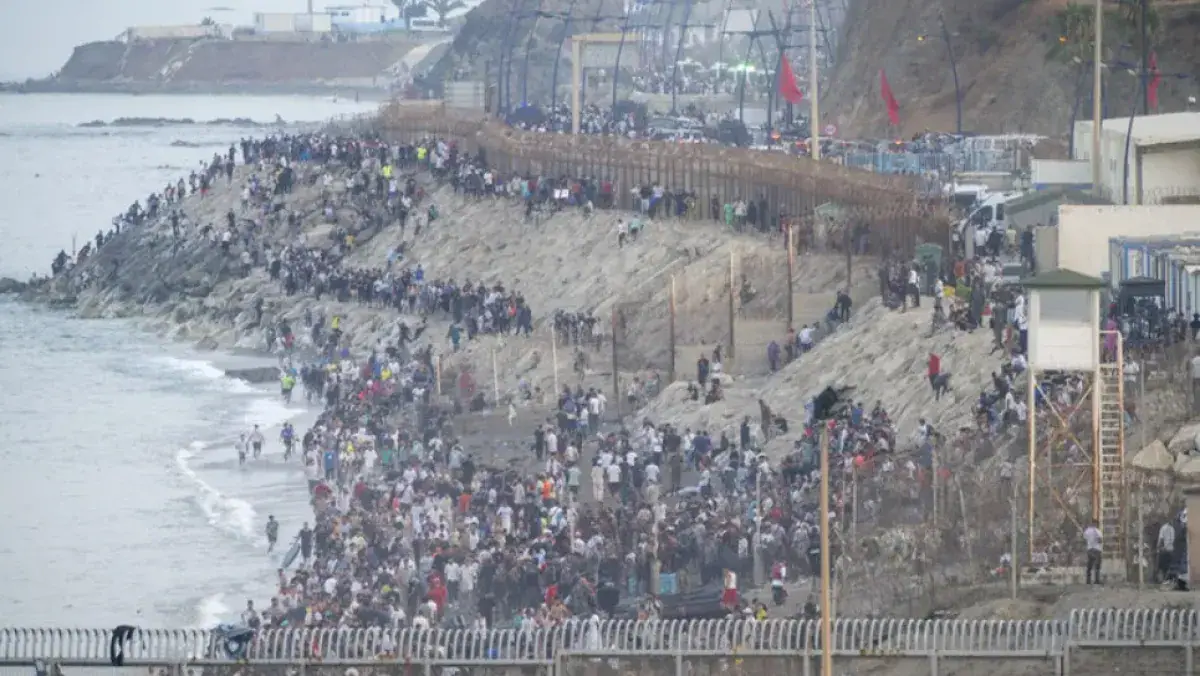
A recent report by Spain's National Center for Immigration and Borders (CENIF) has identified 18 Moroccan officials allegedly involved in a mass migrant crossing into the Spanish city of Ceuta on July 30-31. The report claims the crossing was a "planned and organized" operation by authorities in the Moroccan city of Tangier. CENIF's investigation, which included testimonies from 81 migrants and analysis of images from the incident, implicated various Moroccan officials, including security and civil authorities.
The CENIF report, submitted to Spanish judge Maria Tardon, names several high-ranking officials, including the Wali of Tangier-Tetouan-Al Hoceima region, Youns Tazi, and the Wali of Tangier's security, Mohamed Walidi. The investigation suggests that these officials played a role in coordinating the border crossing, which resulted in 83 migrant deaths. The report contradicts initial claims that the incident was an accident, instead pointing to a coordinated effort involving multiple Moroccan authorities.
The Spanish probe has already led to the identification of two senior Moroccan security officials, Mohamed Walidi and Abdel Fattah Sid Er-Radi, who allegedly issued instructions to migrants during the crossing. CENIF's report expands on this list, implicating additional Moroccan police officials and civil authorities, including local leaders and administrators. The investigation has involved reviewing images, witness testimonies, and social media posts to piece together the events surrounding the migrant crossing.
According to CENIF, the mass crossing was not a spontaneous event but rather a carefully coordinated operation. The presence of multiple Moroccan officials, including high-ranking security personnel, suggests a significant level of planning and organization. The incident highlighted the complexities of migration management and border control in the region, with both Spain and Morocco facing criticism for their handling of the situation.
The investigation has involved extensive research, including analysis of images, witness statements, and social media posts. CENIF's report is based on a thorough examination of evidence, including 13 detailed records of witness testimony and identification of individuals through photographic evidence. The Spanish authorities have been working to determine the extent of Moroccan involvement in the incident and potential implications for bilateral relations.
The incident has strained relations between Spain and Morocco, with both countries seeking to manage the flow of migrants into Europe. The Spanish government has faced criticism for its response to the crisis, while Morocco has been accused of failing to prevent the mass crossing. The CENIF report's findings are likely to exacerbate tensions between the two nations, which have a complex and often contentious relationship.
As the investigation continues, it remains to be seen what consequences the implicated Moroccan officials will face. The incident has highlighted the need for greater cooperation and coordination between European and African nations to address the root causes of migration and prevent similar incidents in the future. The Spanish authorities are expected to pursue further action in response to the CENIF report's findings.
Key points
- 18 Moroccan officials implicated in a mass migrant crossing into Ceuta
- Investigation suggests the crossing was a planned and organized operation
- Incident strained relations between Spain and Morocco