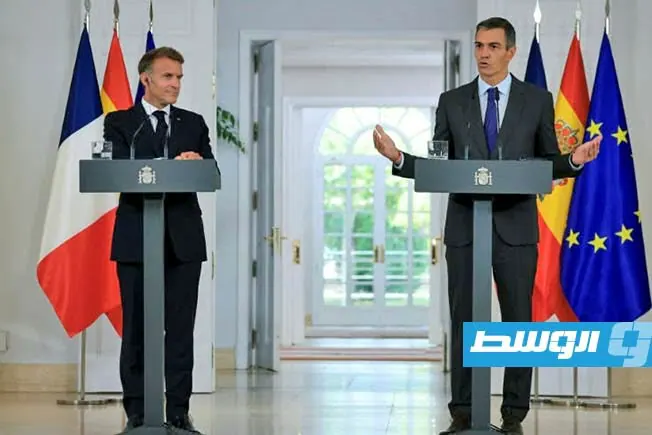
Spanish Prime Minister Pedro Sanchez on Wednesday apologized to French President Emmanuel Macron for the Spanish Senate's rejection of a friendship treaty between the two countries. The treaty was signed in January 2023, and while it had been approved by the Spanish Congress of Deputies and the French National Assembly, the Senate's rejection was a setback. Sanchez described the outcome as "unfortunate" and emphasized that the treaty was not just a bilateral agreement but a commitment between two countries that consider themselves siblings with a shared European future.
The Spanish Senate's rejection of the treaty was largely due to opposition from the conservative People's Party, which holds an absolute majority in the Senate. The party had been opposed to a clause that would have required one government to invite a minister from the other government to attend a cabinet meeting at least once every three months. While the Spanish judiciary had ruled that the treaty was constitutional, the Senate's rejection meant that it could not move forward in its current form.
President Macron, who was visiting Madrid, responded to the Senate's rejection by saying that he understood and respected the decision. He described the outcome as a "setback" rather than a "tragedy" and expressed his hope that the treaty could still be ratified in the future. Macron and Sanchez emphasized their commitment to strengthening ties between France and Spain, despite the setback.
The friendship treaty between France and Spain was seen as a significant step in strengthening bilateral relations between the two countries. It was one of several such treaties that France had signed with European countries, including Germany, Italy, and Poland. For Spain, it was only the second such treaty, following one with Portugal.
Sanchez and Macron were meeting in Madrid for a series of talks aimed at strengthening bilateral cooperation on issues such as migration, security, and economic development. The two leaders emphasized their shared commitment to European integration and to addressing common challenges facing the continent.
The rejection of the treaty was seen as a disappointment for both Sanchez and Macron, who had seen it as a key element in their efforts to strengthen ties between France and Spain. However, both leaders emphasized their commitment to continuing to work together to strengthen bilateral relations and promote European integration.
The incident highlights the complexities of international diplomacy, where agreements can be derailed by domestic politics. Despite the setback, both France and Spain are expected to continue working together on key issues, including migration, security, and economic development.
Key points
- The Spanish Senate's rejection of the friendship treaty was due to opposition from the conservative People's Party.
- President Macron responded to the rejection by expressing understanding and respect for the decision.
- The treaty was seen as a significant step in strengthening bilateral relations between France and Spain.