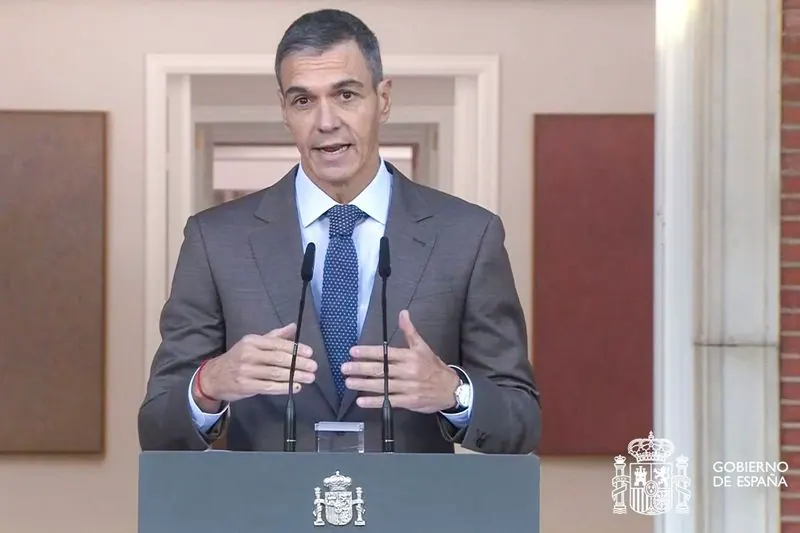
Spanish Prime Minister Pedro Sanchez announced on Monday, October 5, 2026, that he would be calling a snap election for November 29. This decision comes as Sanchez's Socialist Party is trailing in opinion polls, and his government's term has been marked by a series of setbacks and scandals. Despite this, Sanchez has been boosted by recent proposals to tackle the country's mounting housing crisis, which were well received by the public but struck down by right-wing MPs.
Sanchez has been a prominent figure globally for his progressive stance on issues such as Palestinian statehood and defending multilateral institutions. He has also taken a strong stance on cracking down on "tech oligarchs." However, his position at home has been weakened by a series of setbacks and scandals, including allegations of graft against senior members of his own Socialist Party. The party's approval rating has hovered at around 26-31% throughout Sanchez's tenure.
The snap election poses a significant risk for Sanchez, as opinion polls suggest that a coalition led by the conservative People's Party (PP) with the support of Vox is the most likely outcome. This would usher a far-right party into central government for the first time since the return of democracy after the death of dictator Francisco Franco. An election defeat would spell the end of one of Europe's last few left-leaning governments, at a time when the far-right is making unprecedented gains across the region.
Despite the challenges, Sanchez has proven his ability to surprise his critics. He has cobbled together a series of fragile and seemingly impossible coalitions, including voices from the far-left to the separatist right, to remain in power for three successive terms lasting eight years. However, growing fragmentation among his partners has meant that the government has passed little in the way of legislation in its third term and failed to pass a budget since 2023.
Sanchez took office after leading a move to oust centre-right Mariano Rajoy in the wake of major corruption scandals within Rajoy's People's Party. He won early plaudits for moves including the exhumation of Franco from a mausoleum and the reform of a labour law that has seen unemployment fall to its lowest level in almost two decades. He has also cemented his humanitarian and pro-immigration credentials, including accepting the Aquarius migrant rescue ship and its 629 passengers in 2018.
Sanchez's housing measures provided a rare chance for the Socialist leader to pitch himself as the leader of a mobilised left and distract from more politically damaging issues. Economist and president of consultancy Freemarket Corporate Intelligence, Lorenzo Bernaldo de Quiros, said that this was a "window of opportunity" for Sanchez, but that he must act quickly to capitalise on the momentum. If he does not call elections fast, those topics will return to centre stage.
The outcome of the snap election remains uncertain, with Sanchez facing an uphill battle to retain power. However, he has consistently demonstrated his ability to navigate complex political situations and defy expectations. As Spain prepares to head to the polls, the country is bracing for a potentially significant shift in its political landscape.
Key points
- Sanchez's Socialist Party is trailing in opinion polls, but he has been boosted by recent proposals to tackle the country's mounting housing crisis.
- A coalition led by the conservative People's Party (PP) with the support of Vox is the most likely outcome in the snap election.
- Sanchez has proven his ability to surprise his critics, cobbling together fragile coalitions to remain in power for three successive terms.