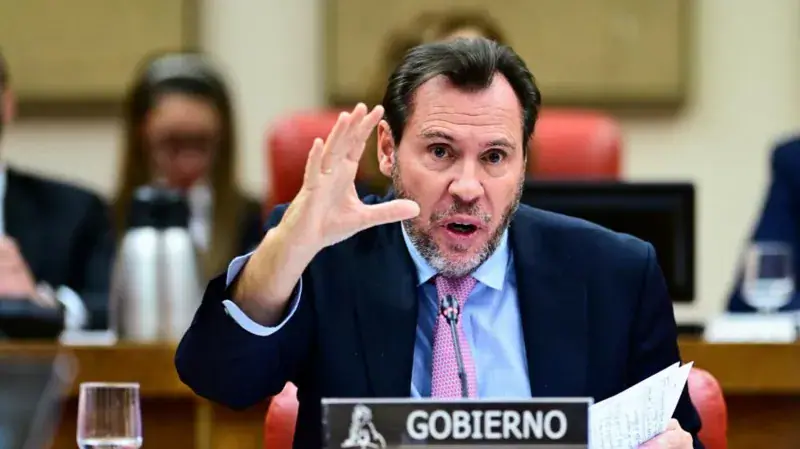
Spain's Transport Minister Óscar Puente has resigned following a deadly high-speed train collision that killed at least 69 people and injured dozens. The accident occurred on October 28 near Urda, south of Madrid, when a Renfe high-speed train struck the rear of a stationary train operated by private company Iryo. Puente announced his departure on Tuesday evening during a session in Congress, where lawmakers questioned him about the collision.
The disaster ranks among Europe's deadliest railway accidents in recent decades and marks Spain's worst train crash since 2013. The accident has placed Spain's railway safety record under growing scrutiny and raised concerns about the reliability of its high-speed network. Puente also announced that he would withdraw his name from the lists for the November 29 early legislative elections.
Political pressure had been mounting on Puente after the crash, with the conservative People's Party (PP) and far-right Vox demanding his resignation. Some government allies also questioned whether he could remain in office. Opposition lawmakers accused Puente of failing to take responsibility for the state of the railway network and criticized his initial remarks about possible human error.
Prime Minister Pedro Sánchez commended Puente's decision, saying he had "faced up to the situation, provided answers and solutions, and then stepped aside." Sánchez added that Puente made the difficult decision "out of dignity. Of his own accord. Out of respect for the victims." The timing of Puente's resignation adds another challenge for Sánchez's government, which faces voters on November 29.
The collision has raised serious questions about the communication between train drivers and railway control staff before the accident. Audio recordings published by Spanish media outlets captured exchanges between Madrid's control center and the drivers of both trains shortly before the collision. The recordings appear to indicate that railway staff knew the Iryo train remained on the track as the Renfe train approached.
Investigators must establish how the two trains ended up on the same stretch of track and whether the procedures in place could have prevented the collision. The Renfe train carried 397 passengers, while the Iryo train had 147 on board. Initial reports pointed to a possible failure in the automatic signalling system, which had forced trains to stop along the affected section.
The resignation of Spain's Transport Minister highlights the government's efforts to address concerns over railway safety and restore public confidence in the wake of the deadly train crash. The disaster has become a major political issue, with the opposition likely to question the government's oversight of railway safety.
Key points
- Óscar Puente resigned as Spain's Transport Minister following a deadly train crash that killed 69 people.
- The accident has raised questions about railway safety and the government's handling of the disaster.
- The resignation comes ahead of the November 29 early legislative elections, adding another challenge for Prime Minister Pedro Sánchez's government.