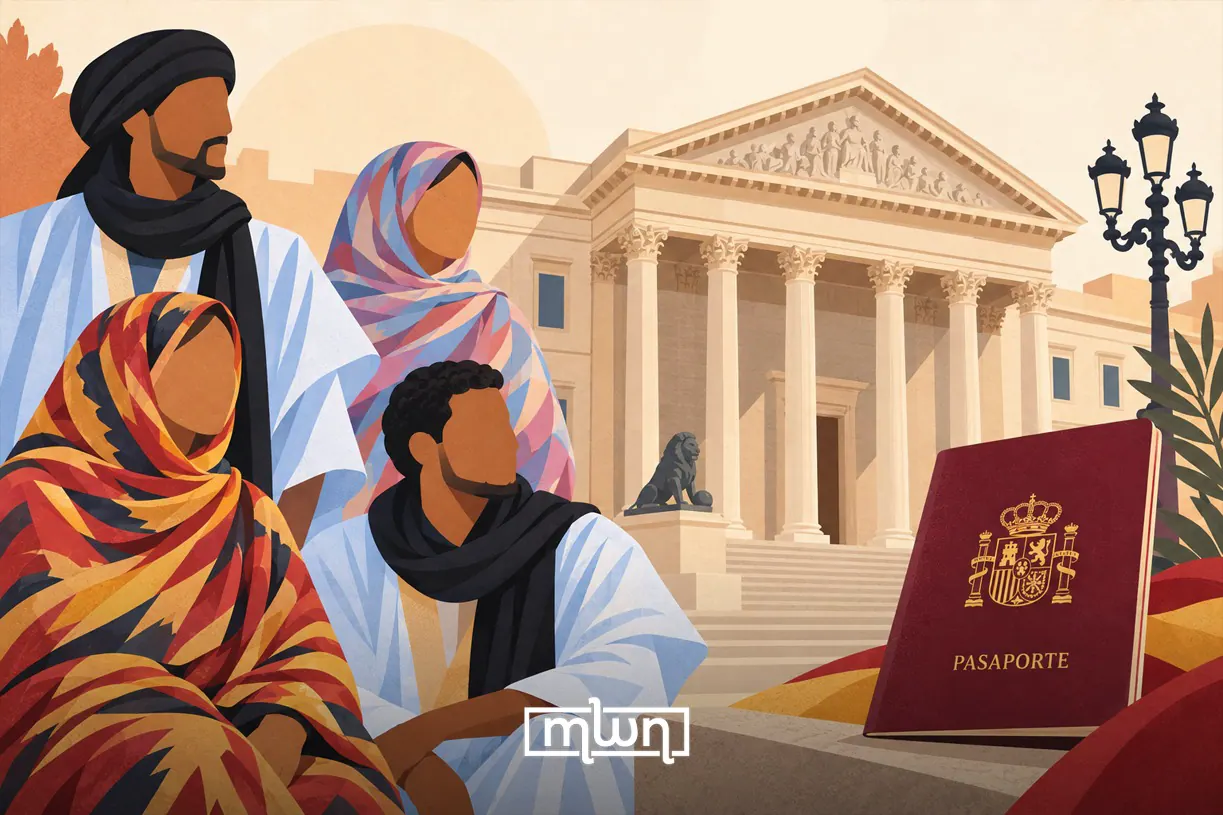
A Spanish bill that aimed to grant nationality to Sahrawis born under Spanish administration has collapsed after Prime Minister Pedro Sánchez called an early election for November 29. The bill, which had nearly been passed, would have allowed Sahrawis born in the territory before September 29, 1977, and their first-degree descendants to obtain Spanish nationality through a carta de naturaleza, an exceptional naturalization requiring no residence in Spain.
The bill had been introduced by Sumar in 2024, but faced opposition from the PSOE, who voted against examining it in February 2025. A deal was struck between Socialists and Sumar in June 2026, and the Justice Commission cleared the bill in July. The Congress adopted it on September 10 with 168 votes in favor, 31 against, and 145 abstentions. However, the call for an early election has voided the initiative.
The proposed law had sparked controversy, with critics arguing it was an attempt to interfere with Morocco's territorial integrity. The bill's supporters argued it was a humanitarian measure to provide nationality to those born under Spanish administration. Estimates suggested that between 70,000 to 80,000 people, and potentially up to 200,000 with descendants, could have benefited from the law.
The Polisario separatist group's representative in Spain attended the vote, and the group's leader, Tesh Sidi, expressed disappointment at the bill's collapse. Sidi stated that the measure had been "approved by broad majorities" and would now end up "in the trash." The bill's collapse has left two possible routes for Sahrawis to obtain nationality: the PP withdrawing its Senate amendments or the government conferring nationality case by case through royal decree.
Critics argue that the bill was rooted in colonial logic, as it relied on Spain's past administration of the territory to grant nationality. The bill's preamble conceded that the Franco regime had converted its African colonies into provinces to circumvent UN decolonization, but then used this same provincialization to justify the passport. Defenders of the bill called it "restitution," but others argued that it was an attempt to impose Spanish identity on people who may have been born and raised in Morocco or elsewhere.
The effects of the bill's collapse will not be limited to Spain, as it could have implications for the European Union. Article 20 of the EU treaty turns any Spanish nationality automatically into Union citizenship. Analysts have questioned whether Madrid had considered the consequences of granting nationality to Sahrawis, including the potential for them to settle in occupied Ceuta or Melilla, and the impact on relations with Morocco.
The collapse of the bill has exposed the complexities of the Sahrawi issue, with many in the Tindouf camps seeing the passport as an escape hatch rather than a means of building a nation. The Sahrawi association behind the campaign has pledged to table the law again in the next legislature. For now, Spain's bid to convert its colonial past into a passport has stalled on the timing of its own politics.
Key points
- The Spanish bill granting nationality to Sahrawis was rooted in colonial logic and has collapsed after the snap election call.
- The bill's collapse has left Sahrawis with limited options for obtaining nationality, and has exposed the complexities of the Sahrawi issue.
- The effects of the bill's collapse will have implications for the European Union, including the potential for Sahrawis to settle in occupied Ceuta or Melilla.