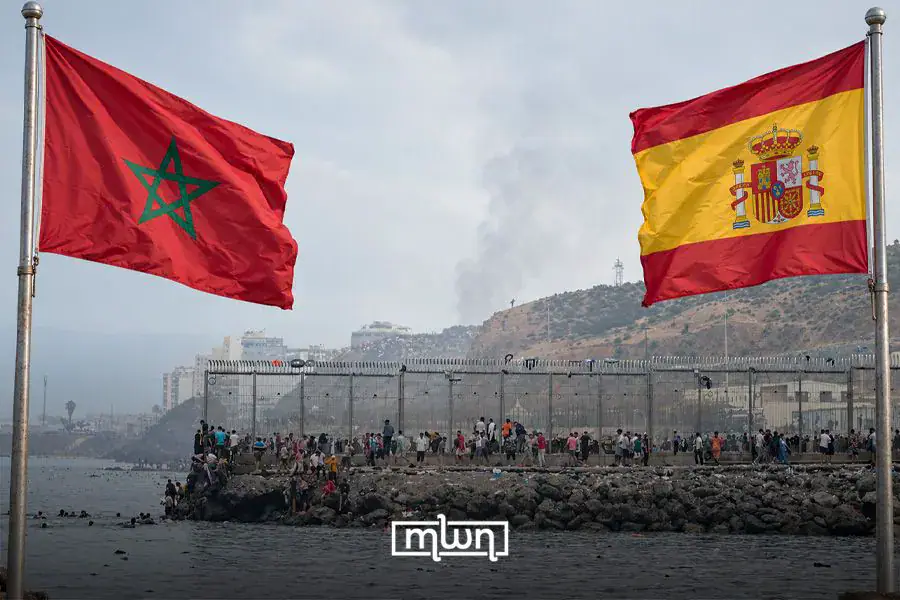
A recent testimony by Miguel Lobo, head of operations at the Civil Guard's Ceuta command, has added to the confusion over Spain's narrative on the Ceuta crisis. Lobo made accusations against Morocco's security forces, claiming they stood idle during the crisis. However, these claims contradict reports from the Civil Guard's own Information Headquarters. Lobo's testimony before Judge María Tardón has raised questions about the Spanish state's security apparatus and potential turf wars between different branches.
According to Lobo, small Moroccan vessels were picking migrants out of the water and bringing them closer to the beach during the mass entry of July 30. This account contradicts a previous claim that Moroccan warships threw previously rescued migrants overboard when they saw a Spanish Maritime Rescue vessel approaching. The conflicting accounts from the same Spanish state agencies have raised questions about the credibility of Spain's claims against Morocco.
The Civil Guard's Information Headquarters reported that Moroccan security forces intercepted 493 of the 1,109 people who tried to swim into Ceuta between 8 a.m. on July 29 and 8 a.m. on July 30. This represents 44.5% of all attempts made during that period. The report, written while the mass crossings were still taking place, concluded that it was "very unlikely" the Moroccan monarchy was using migration to retaliate against Spanish interests.
The conflicting accounts have diverted attention from a more fundamental issue: how can a sovereign state like Spain hand over a large share of its border protection to another country? Spanish authorities have demanded that thousands of Moroccan personnel be stationed along the Ceuta border, and have criticized any reduction in their involvement as "passivity." However, the same authorities have been lenient in explaining their own officials' decisions, such as opening a gate in the border fence.
Lobo justified his decision to open a gate in the fence by citing the risk of people being crushed and migrants jumping into the sea. However, a CNI report drafted on the same day noted that Moroccan riot units were deployed when large numbers of migrants threw themselves into the sea and began trying to swim around the border breakwater. This has raised questions about the application of different standards on both sides of the border.
The Ceuta crisis saw over 70,000 people enter the occupied city in July. The incident has sparked a diplomatic row between Spain and Morocco, with Spain making accusations against Morocco's handling of the situation. However, the conflicting accounts from Spanish state agencies have undermined Spain's claims against Morocco.
The crisis has highlighted the complexities of border management and the challenges of coordinating between different agencies and countries. As Spain and Morocco navigate their diplomatic relationship, it remains to be seen how they will address the issues raised by the Ceuta crisis and work towards a more coordinated approach to border management.
Key points
- Spain's official records contradict its claims against Morocco over the Ceuta crisis.
- Conflicting accounts from Spanish state agencies have raised questions about the credibility of Spain's narrative on the crisis.
- The crisis has highlighted the complexities of border management and the challenges of coordinating between different agencies and countries.