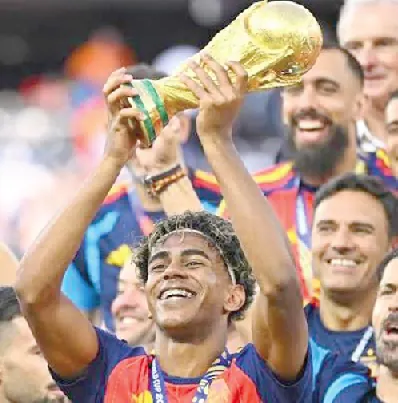
Spain's men's football team has been on an unprecedented 38-match unbeaten run, with their last defeat being a 1-0 loss to Colombia in a 2024 friendly. Their success is not limited to the senior team, as they have also won six Under-19 European Championships, three Under-21 European Championships, and the Women's World Cup in 2023. This dominance has been attributed to a strong coaching culture, which has been developed over the years through various factors.
According to Spain football expert Guillem Balague, there are three pillars that explain Spain's coaching culture and its unprecedented success. The first pillar is the university system, particularly the National Institute of Physical Education, which has been producing physical coaches and football coaches with a deep understanding of learning and training processes since the 1990s. This has led to the emergence of successful managers like Rafa Benitez and Marcelino Garcia Toral.
The second pillar is the Basque culture, which emphasizes hard work and a strong work ethic. The Basque Country has a special reference within Spanish football, with clubs like Athletic Bilbao and Real Sociedad producing talented players. Five players from the region were part of the 2026 World Cup squad, including Unai Simon, Aymeric Laporte, and Nico Williams, who have all contributed to Spain's recent success.
The third pillar is the Barcelona influence, particularly the tactical revolution brought about by Johan Cruyff and later mirrored by Pep Guardiola. Barcelona's La Masia academy has produced many talented players, including eight players who were part of the Spain squad that won the 2010 World Cup and another eight who were part of the 2026 World Cup squad. The academy's focus on ball possession and positional play has been key to Spain's success.
Jordi Gratacos, Barcelona's international director of academies, emphasized the importance of creating intelligent players who can make decisions on the pitch. He highlighted the need for players to understand the tactical meaning of technical actions and to be able to read the game. This approach has been successful, as seen in the careers of players like Xavi, Andres Iniesta, and Sergio Busquets.
The Basque culture has also had a significant impact on Spanish football, with its emphasis on hard work, discipline, and resilience. Cesar Azpilicueta, a former Chelsea captain and Spain international, described the Basque culture as "discipline, the culture of working hard, of not giving up or being resilient." This culture has been embodied by players like Mikel Merino, who scored a quarter-final winner against Germany at Euro 2024.
The education of coaches has also been a crucial factor in Spain's success. Former Liverpool boss Rafael Benitez highlighted the difference in coaching education between Spain and England, with Spanish coaches having a deeper understanding of football and sports science. This has led to the emergence of successful Spanish coaches like Mikel Arteta, Unai Emery, Xabi Alonso, and Andoni Iraola, who are now in charge at four of England's biggest clubs.
Key points
- Spain's dominance in football can be attributed to a strong coaching culture developed through university education, Basque culture, and the Barcelona influence.